Ch.3 - Molecules and Compounds
Tro - Chemistry: A Molecular Approach 6th Edition
Tro6th EditionChemistry: A Molecular ApproachISBN: 9780137832217Non è quello che usi tu?Cambia libro di testo
Capitolo 3, Problema 41

What is the appropriate name for each ionic compound: a. SnO, b. Cr2S3, c. RbI, d. BaBr2?

Guida verificata passo dopo passo
1
Identify the cation and anion in each compound.
Determine the charge of the cation based on the anion's charge and the overall neutrality of the compound.
For transition metals, use Roman numerals to indicate the cation's charge in the compound's name.
Combine the cation name and the anion name, ensuring the anion ends with '-ide'.
Write the full name of each compound using the rules for naming ionic compounds.

Concetti chiave

Ecco i concetti essenziali che devi comprendere per rispondere correttamente alla domanda.

Ionic Compounds

Ionic compounds are formed when metals transfer electrons to nonmetals, resulting in the formation of positively charged cations and negatively charged anions. These oppositely charged ions attract each other, creating a stable compound. The naming of ionic compounds typically involves stating the cation first, followed by the anion, with the anion's name often modified to end in '-ide' for simple binary compounds.
Video consigliato:
Percorso guidato
02:11
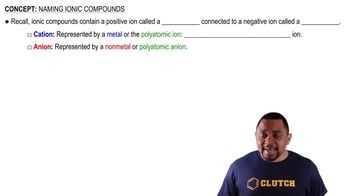
Ionic Compounds Naming

Naming Cations and Anions

Cations are usually named after the metal element, while anions are named based on the root of the element's name with an '-ide' suffix for simple anions. For transition metals, the oxidation state is indicated using Roman numerals in parentheses. Understanding how to identify and name these ions is crucial for correctly naming ionic compounds.
Video consigliato:
Percorso guidato
03:23
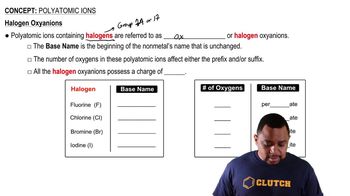
Halogen Oxyanions Naming

Common Ionic Compounds

Certain ionic compounds have widely accepted names that may not follow the standard naming rules. For example, tin (Sn) can form multiple oxidation states, and its oxide is commonly referred to as tin(II) oxide when Sn has a +2 charge. Familiarity with common ionic compounds and their names helps in accurately identifying and naming compounds in chemical contexts.
Video consigliato:
Percorso guidato
02:11
Ionic Compounds Naming