Ch.3 - Molecules and Compounds
Tro - Chemistry: A Molecular Approach 6th Edition
Tro6th EditionChemistry: A Molecular ApproachISBN: 9780137832217Non è quello che usi tu?Cambia libro di testo
Capitolo 3, Problema 30

Identify the elements that have molecules as their basic units. a. nitrogen b. argon c. hydrogen d. helium

Guida verificata passo dopo passo
1
Understand that elements can exist as individual atoms or as molecules. Molecules are groups of two or more atoms bonded together.
Recognize that diatomic molecules are a common form for some elements. These are molecules composed of two atoms of the same element.
Identify the diatomic elements, which include hydrogen (H2), nitrogen (N2), oxygen (O2), fluorine (F2), chlorine (Cl2), bromine (Br2), and iodine (I2).
Analyze the given options: a. nitrogen, b. argon, c. hydrogen, d. helium.
Determine which of these elements exist naturally as diatomic molecules: nitrogen (N2) and hydrogen (H2). Argon and helium are noble gases and exist as individual atoms.

Risposta video verificata per un problema simile:

Questa soluzione video è stata consigliata dai nostri tutor come utile per risolvere questo problema.
Durata del video:
3m

Concetti chiave

Ecco i concetti essenziali che devi comprendere per rispondere correttamente alla domanda.

Molecular vs. Atomic Elements

Elements can exist as individual atoms or as molecules. Atomic elements, like helium and argon, consist of single atoms, while molecular elements, such as hydrogen, exist as diatomic molecules (H2). Understanding this distinction is crucial for identifying which elements have molecules as their basic units.
Video consigliato:
Percorso guidato
04:13
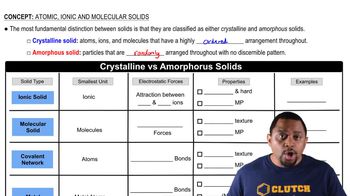
Crystalline vs Amorphous Solids

Diatomic Molecules

Diatomic molecules are composed of two atoms, which can be of the same or different elements. In the context of the question, hydrogen (H2) is a diatomic molecule, meaning its basic unit is a pair of hydrogen atoms bonded together. Recognizing diatomic molecules helps in identifying elements that form molecular structures.
Video consigliato:
Percorso guidato
03:10
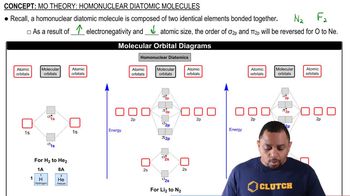
Homonuclear Diatomic Molecules

Noble Gases

Noble gases, such as argon and helium, are characterized by their full valence electron shells, making them chemically inert and typically existing as single atoms rather than molecules. This property distinguishes them from other elements that form molecular structures, which is essential for answering the question about basic units.
Video consigliato:
Percorso guidato
00:44
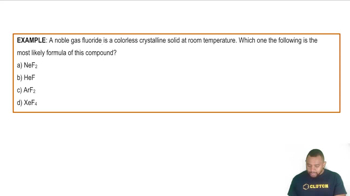
Noble Gas Compounds Example