Combustion analysis of naphthalene, a hydrocarbon used in mothballs, produces 8.80 g CO2 and 1.44 g H2O. Calculate the empirical formula of naphthalene.
Ch.3 - Molecules and Compounds

Tro6th EditionChemistry: A Molecular ApproachISBN: 9780137832217Non è quello che usi tu?Cambia libro di testo
Capitolo 3, Problema 107
The foul odor of rancid butter is due largely to butyric acid, a compound containing carbon, hydrogen, and oxygen. Combustion analysis of a 4.30-g sample of butyric acid produces 8.59 g CO2 and 3.52 g H2O. Determine the empirical formula of butyric acid.
Guida verificata passo dopo passo1
Calculate the moles of carbon in the CO2 produced. Use the molar mass of CO2 (44.01 g/mol) and the fact that each mole of CO2 contains one mole of carbon.
Calculate the moles of hydrogen in the H2O produced. Use the molar mass of H2O (18.02 g/mol) and the fact that each mole of H2O contains two moles of hydrogen.
Determine the mass of carbon and hydrogen in the original sample using the moles calculated and the atomic masses of carbon (12.01 g/mol) and hydrogen (1.008 g/mol).
Calculate the mass of oxygen in the original sample by subtracting the mass of carbon and hydrogen from the total mass of the sample (4.30 g).
Convert the mass of oxygen to moles using the atomic mass of oxygen (16.00 g/mol), then determine the simplest whole number ratio of moles of C, H, and O to find the empirical formula.

Risposta video verificata per un problema simile:
Questa soluzione video è stata consigliata dai nostri tutor come utile per risolvere questo problema.
Durata del video:
4mConcetti chiave
Ecco i concetti essenziali che devi comprendere per rispondere correttamente alla domanda.
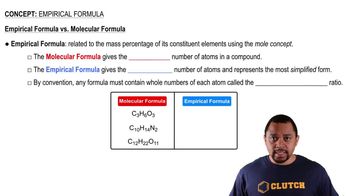
Empirical Formula
The empirical formula of a compound represents the simplest whole-number ratio of the elements present in that compound. It is derived from the relative amounts of each element, typically determined through experimental data such as combustion analysis. For butyric acid, the empirical formula can be calculated by converting the mass of carbon and hydrogen obtained from combustion into moles and then finding the simplest ratio.
Video consigliato:
Percorso guidato
Empirical vs Molecular Formula
Combustion Analysis
Combustion analysis is a technique used to determine the composition of organic compounds by burning a known mass of the sample in excess oxygen. The products of combustion, primarily carbon dioxide (CO2) and water (H2O), are measured to calculate the amounts of carbon and hydrogen in the original sample. This method is essential for finding the empirical formula of compounds like butyric acid.
Video consigliato:
Percorso guidato
Combustion of Non-Hydrocarbons
Stoichiometry
Stoichiometry is the branch of chemistry that deals with the quantitative relationships between the reactants and products in a chemical reaction. It allows chemists to calculate the amounts of substances consumed and produced in a reaction based on balanced chemical equations. In the context of butyric acid, stoichiometry is used to relate the masses of CO2 and H2O produced to the moles of carbon and hydrogen in the original compound.
Video consigliato:
Percorso guidato
Stoichiometry Concept
Pratica correlata
Domanda del libro di testo
1868
views
Domanda del libro di testo
Combustion analysis of a hydrocarbon produces 33.01 g CO2 and 13.51 g H2O. Calculate the empirical formula of the hydrocarbon.
4733
views
Domanda del libro di testo
Tartaric acid is the white, powdery substance that coats tart candies such as Sour Patch Kids. Combustion analysis of a 12.01-g sample of tartaric acid—which contains only carbon, hydrogen, and oxygen—produces 14.08 g CO2 and 4.32 g H2O. Determine the empirical formula of tartaric acid.
2236
views
Domanda del libro di testo
Classify each hydrocarbon as an alkane, alkene, or alkyne. a. H2C=CH−CH3 b. H3C−CH2−CH3 c. HC≡C−CH3 d. H3C−CH2−CH2−CH3
290
views
Domanda del libro di testo
From the given molar mass and empirical formula of several compounds, find the molecular formula of each compound. c. C3H2N, 312.29 g/mol
1276
views