Ch.3 - Molecules and Compounds
Tro - Chemistry: A Molecular Approach 6th Edition
Tro6th EditionChemistry: A Molecular ApproachISBN: 9780137832217Non è quello che usi tu?Cambia libro di testo
Capitolo 3, Problema 88b

Write a ratio showing the relationship between the molar amounts of each element for each compound. (See Appendix IIA for color codes.) (b)
Molecular models of H, N, and C compounds with a color-coded key for elements.

Guida verificata passo dopo passo
1
Identify the elements in the molecular models using the color code provided: White for Hydrogen (H), Green for Nitrogen (N), and Pink for Carbon (C).
Count the number of each type of atom in one of the molecular models. For example, count the number of white (H), green (N), and pink (C) spheres in one molecule.
Write down the molar amounts of each element in the form of a ratio. For instance, if a molecule has 2 H, 1 N, and 1 C, the ratio would be H:N:C = 2:1:1.
Repeat the counting process for each different molecular model shown in the image to ensure consistency and accuracy.
Compare the ratios obtained for each molecular model to understand the relationship between the molar amounts of each element in the compounds.

Risposta video verificata per un problema simile:

Questa soluzione video è stata consigliata dai nostri tutor come utile per risolvere questo problema.
Durata del video:
2m

Concetti chiave

Ecco i concetti essenziali che devi comprendere per rispondere correttamente alla domanda.

Molar Ratios

Molar ratios express the relationship between the amounts of different substances in a chemical reaction or compound. They are derived from the coefficients in a balanced chemical equation and indicate how many moles of one substance react with or produce moles of another. Understanding molar ratios is essential for stoichiometric calculations in chemistry.
Video consigliato:
Percorso guidato
02:14
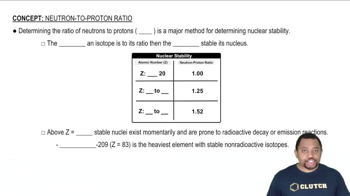
Neutron-Proton Ratio

Chemical Formulas

Chemical formulas represent the composition of a compound, showing the types and numbers of atoms present. For example, in the formula C2H6, there are two carbon atoms and six hydrogen atoms. Analyzing chemical formulas allows students to determine the molar amounts of each element in a compound, which is crucial for calculating ratios.
Video consigliato:
Percorso guidato
02:26
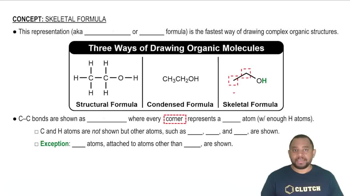
Skeletal Formula

Molecular Models

Molecular models visually represent the three-dimensional arrangement of atoms within a molecule. They help in understanding the spatial relationships and bonding between different atoms. The image provided illustrates molecular models of compounds containing hydrogen (H), nitrogen (N), and carbon (C), which aids in visualizing how these elements combine and their respective ratios in the compounds.
Video consigliato:
Percorso guidato
02:43
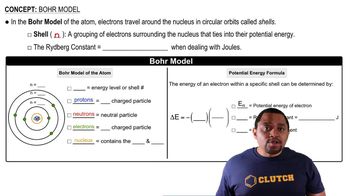
Bohr Model of the Atom