Elemental phosphorus reacts with chlorine gas according to the equation: P4(s) + 6 Cl2( g) → 4 PCl3(l) A reaction mixture initially contains 91.38 g P4 and 262.6 g Cl2. Once the reaction has occurred as completely as possible, what mass (in g) of the excess reactant remains?

Iron(III) oxide reacts with carbon monoxide according to the equation: Fe2O3(s) + 3 CO(g) → 2 Fe(s) + 3 CO2(g) A reaction mixture initially contains 45.10 g Fe2O3 and 29.56 g CO. Once the reaction has occurred as completely as possible, what mass (in g) of the excess reactant remains?
Guida verificata passo dopo passo
Risposta video verificata per un problema simile:
Concetti chiave
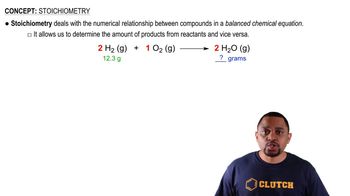
Stoichiometry
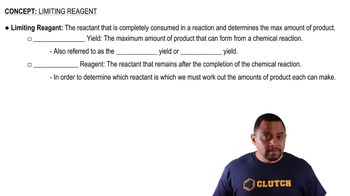
Limiting Reactant
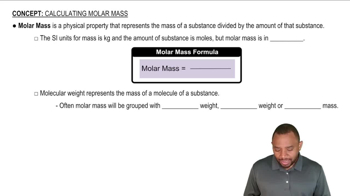
Molar Mass
For the reaction shown, calculate the theoretical yield of product (in grams) for each initial amount of reactants. 2 Al(s) + 3 Cl2(g) → 2 AlCl3(s) c. 0.235 g Al, 1.15 g Cl2
Magnesium oxide can be made by heating magnesium metal in the presence of oxygen. The balanced equation for the reaction is: 2 Mg(s) + O2(g) → 2 MgO(s) When 13.1 g of Mg reacts with 13.6 g O2, 12.4 g MgO is collected. Determine the limiting reactant, theoretical yield, and percent yield for the reaction.
For the reaction shown, calculate the theoretical yield of the product (in grams) for each initial amount of reactants. Ti(s) + 2 F2( g) → TiF4(s) c. 0.233 g Ti, 0.288 g F2
Urea (CH4N2O) is a common fertilizer that is synthesized by the reaction of ammonia (NH3) with carbon dioxide: 2 NH3(aq) + CO2(aq) → CH4N2O(aq) + H2O(l) In an industrial synthesis of urea, a chemist combines 149.4 kg of ammonia with 231.1 kg of carbon dioxide and obtains 172.3 kg of urea. Determine the limiting reactant, theoretical yield of urea, and percent yield for the reaction.
