Ch.5 - Introduction to Solutions and Aqueous Solutions
Tro - Chemistry: A Molecular Approach 6th Edition
Tro6th EditionChemistry: A Molecular ApproachISBN: 9780137832217Non è quello che usi tu?Cambia libro di testo
Capitolo 5, Problema 45c

A 25.0-mL sample of a 1.20 M potassium chloride solution is mixed with 15.0 mL of a 0.900 M lead(II) nitrate solution and this precipitation reaction occurs: 2 KCl(aq) + Pb(NO3)2(aq) → PbCl2(s) + 2 KNO3(aq) The solid PbCl2 is collected, dried, and found to have a mass of 2.45 g. Determine the the percent yield.

Guida verificata passo dopo passo
1
Calculate the moles of KCl in the 25.0 mL of 1.20 M solution using the formula: \( \text{moles} = \text{molarity} \times \text{volume in liters} \).
Calculate the moles of Pb(NO_3)_2 in the 15.0 mL of 0.900 M solution using the same formula: \( \text{moles} = \text{molarity} \times \text{volume in liters} \).
Determine the limiting reactant by comparing the mole ratio from the balanced equation: 2 KCl reacts with 1 Pb(NO_3)_2.
Calculate the theoretical yield of PbCl_2 using the moles of the limiting reactant and the stoichiometry of the reaction.
Calculate the percent yield using the formula: \( \text{percent yield} = \left( \frac{\text{actual yield}}{\text{theoretical yield}} \right) \times 100\).

Risposta video verificata per un problema simile:

Questa soluzione video è stata consigliata dai nostri tutor come utile per risolvere questo problema.

Concetti chiave

Ecco i concetti essenziali che devi comprendere per rispondere correttamente alla domanda.

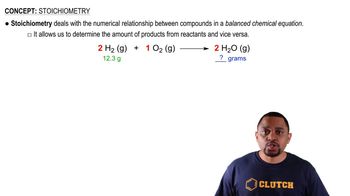
Stoichiometry

Stoichiometry is the calculation of reactants and products in chemical reactions based on the balanced chemical equation. It allows us to determine the amount of product formed from given quantities of reactants. In this case, stoichiometry is essential to find the theoretical yield of lead(II) chloride (PbCl2) from the initial concentrations and volumes of potassium chloride (KCl) and lead(II) nitrate (Pb(NO3)2).
Video consigliato:
Percorso guidato
01:16
Stoichiometry Concept

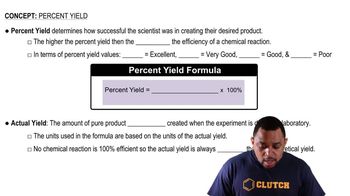
Percent Yield

Percent yield is a measure of the efficiency of a chemical reaction, calculated by comparing the actual yield of a product to the theoretical yield. It is expressed as a percentage and is calculated using the formula: (actual yield / theoretical yield) × 100%. In this problem, the actual yield is the mass of PbCl2 collected, while the theoretical yield is determined from stoichiometric calculations.
Video consigliato:
Percorso guidato
03:09
Percent Yield in Reactions

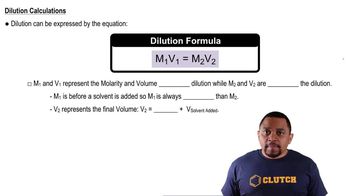
Molarity and Dilution

Molarity (M) is a concentration unit defined as the number of moles of solute per liter of solution. It is crucial for determining the amount of reactants in a solution. In this question, the molarity of KCl and Pb(NO3)2 solutions is used to calculate the moles of each reactant before the reaction occurs, which is necessary for stoichiometric calculations and determining the theoretical yield.
Video consigliato:
Percorso guidato
00:58
Dilution Equation