Ch.5 - Introduction to Solutions and Aqueous Solutions
Tro - Chemistry: A Molecular Approach 6th Edition
Tro6th EditionChemistry: A Molecular ApproachISBN: 9780137832217Non è quello che usi tu?Cambia libro di testo
Capitolo 5, Problema 51b

Complete and balance each equation. If no reaction occurs, write 'NO REACTION.' b. KCl(aq) + CaS(aq) →

Guida verificata passo dopo passo
1
Identify the reactants: KCl(aq) and CaS(aq).
Determine the possible products by exchanging the cations and anions: KCl + CaS → K2S + CaCl2.
Check the solubility of the products: K2S is soluble, CaCl2 is soluble.
Since both products are soluble, no precipitate forms, indicating no reaction occurs.
Write the final statement: 'NO REACTION.'

Risposta video verificata per un problema simile:

Questa soluzione video è stata consigliata dai nostri tutor come utile per risolvere questo problema.
Durata del video:
1m

Concetti chiave

Ecco i concetti essenziali che devi comprendere per rispondere correttamente alla domanda.

Double Displacement Reaction

A double displacement reaction, also known as a double replacement reaction, occurs when two compounds exchange ions to form two new compounds. In this type of reaction, the cations and anions of the reactants switch partners, which can lead to the formation of a precipitate, gas, or water. Understanding this concept is crucial for predicting the products of the reaction between KCl and CaS.
Video consigliato:
Percorso guidato
01:11
Single Displacement Reactions

Solubility Rules

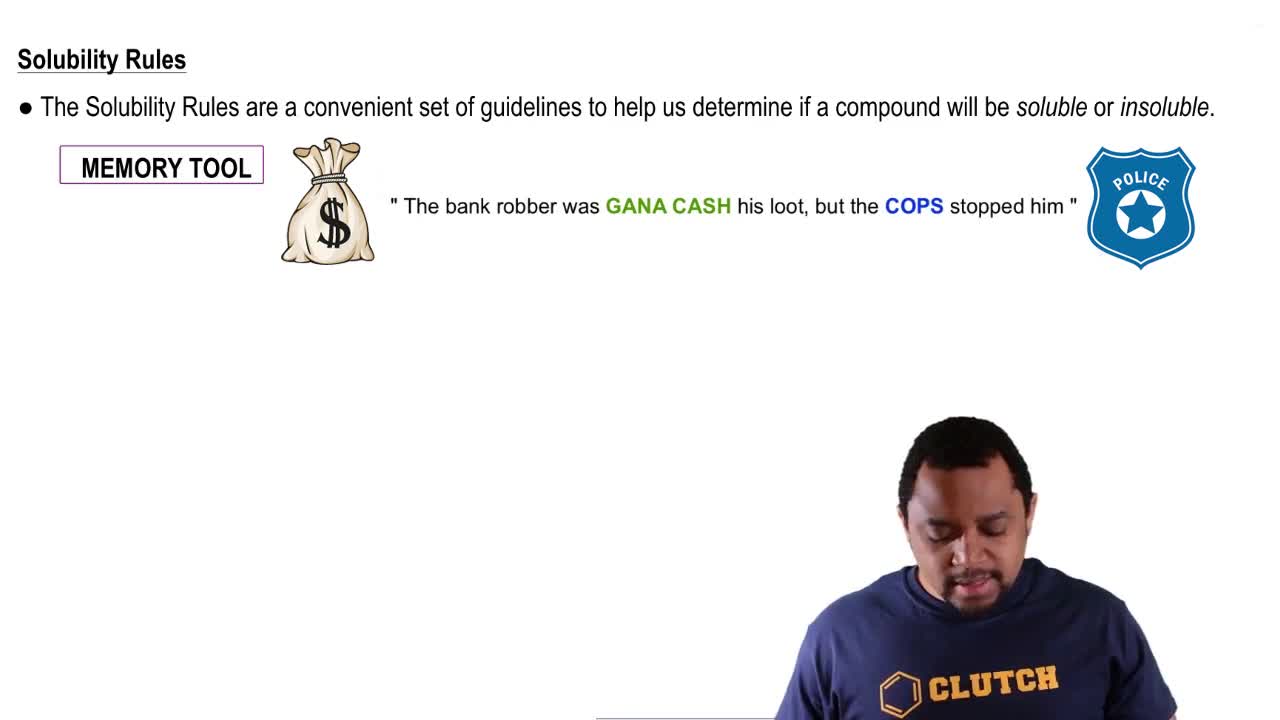
Solubility rules are guidelines that help predict whether a compound will dissolve in water or form a precipitate. For example, most chlorides are soluble, while sulfides are generally insoluble except for those of alkali metals and alkaline earth metals. Applying these rules to the reactants KCl and CaS will help determine if a reaction occurs and what the products will be.
Video consigliato:
Percorso guidato
00:28
Solubility Rules

Balancing Chemical Equations

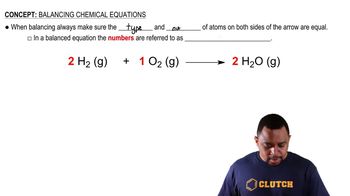
Balancing chemical equations is the process of ensuring that the number of atoms for each element is the same on both sides of the equation. This is based on the law of conservation of mass, which states that matter cannot be created or destroyed in a chemical reaction. Properly balancing the equation for the reaction between KCl and CaS is essential for accurately representing the reaction and its products.
Video consigliato:
Percorso guidato
01:32
Balancing Chemical Equations