A 25.00-mL sample of an unknown H3PO4 solution is titrated with a 0.150 M NaOH solution. The equivalence point is reached when 22.97 mL of NaOH solution is added. What is the concentration of the unknown H3PO4 solution? The neutralization reaction is H3PO4(aq) + 3 NaOH(aq) → 3 H2O(l) + Na3PO4(aq)
Ch.5 - Introduction to Solutions and Aqueous Solutions

Tro6th EditionChemistry: A Molecular ApproachISBN: 9780137832217Non è quello che usi tu?Cambia libro di testo
Tutti i libri di testo
Tro 6th Edition
Ch.5 - Introduction to Solutions and Aqueous Solutions
Problema 67c
Tro 6th Edition
Ch.5 - Introduction to Solutions and Aqueous Solutions
Problema 67cCapitolo 5, Problema 67c
Complete and balance each gas-evolution equation. c. HBr(aq) + Na2S(aq) →
Guida verificata passo dopo passo1
Identify the reactants: Hydrobromic acid (HBr) and sodium sulfide (Na2S).
Determine the products: When an acid reacts with a sulfide, hydrogen sulfide gas (H2S) is typically evolved, along with a salt. In this case, the salt is sodium bromide (NaBr).
Write the unbalanced chemical equation: HBr(aq) + Na2S(aq) → H2S(g) + NaBr(aq).
Balance the equation: Start by balancing the number of sodium (Na) atoms, then balance the bromine (Br) atoms, and finally ensure the hydrogen (H) and sulfur (S) atoms are balanced.
Verify the balanced equation: Check that the number of each type of atom is the same on both sides of the equation and that the charges are balanced.

Risposta video verificata per un problema simile:
Questa soluzione video è stata consigliata dai nostri tutor come utile per risolvere questo problema.
Durata del video:
3mConcetti chiave
Ecco i concetti essenziali che devi comprendere per rispondere correttamente alla domanda.
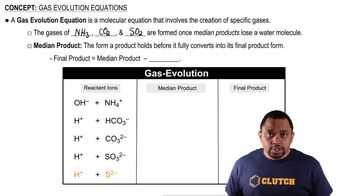
Gas-Evolution Reactions
Gas-evolution reactions are chemical reactions that produce a gas as one of the products. These reactions often involve the combination of an acid with a sulfide, carbonate, or bicarbonate, leading to the release of gases such as H2S, CO2, or NH3. Understanding the nature of the reactants and the expected gaseous products is crucial for predicting the outcome of these reactions.
Video consigliato:
Percorso guidato
Gas Evolution Reactions
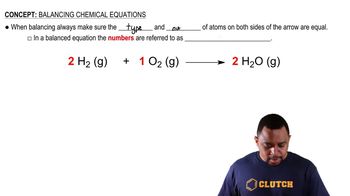
Balancing Chemical Equations
Balancing chemical equations is the process of ensuring that the number of atoms for each element is the same on both the reactant and product sides of the equation. This is achieved by adjusting the coefficients of the compounds involved. A balanced equation reflects the law of conservation of mass, which states that matter cannot be created or destroyed in a chemical reaction.
Video consigliato:
Percorso guidato
Balancing Chemical Equations
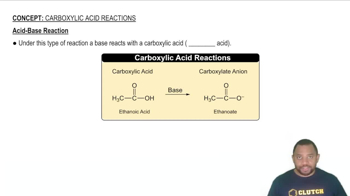
Acid-Base Reactions
Acid-base reactions involve the transfer of protons (H+) between reactants. In the case of HBr and Na2S, HBr acts as an acid, donating a proton, while Na2S, containing the sulfide ion (S2-), can accept protons. Recognizing the roles of acids and bases in a reaction helps in predicting the products formed, including any gases that may evolve.
Video consigliato:
Percorso guidato
Acid-Base Reaction
Pratica correlata
Domanda del libro di testo
A 15.00-mL sample of an unknown HClO4 solution requires titration with 17.03 mL of 0.1000 M NaOH to reach the equivalence point. What is the concentration of the unknown HClO4 solution? The neutralization reaction is HClO4(aq) + NaOH(aq) → H2O(l ) + NaClO4(aq)
Domanda del libro di testo
Assign oxidation states to each atom in each element, ion, or compound. Cl2, Fe3+, CuCl2, CH4, Cr2O72–, HSO4–
954
views
Domanda del libro di testo
Complete and balance each gas-evolution equation. a. HNO3(aq) + Na2SO3(aq) →
1007
views
Domanda del libro di testo
Complete and balance each gas-evolution equation. b. NH4I(aq) + NaOH(aq) →
759
views
Domanda del libro di testo
Assign oxidation states to each atom in each element, ion, or compound. Ag, Ca2+, BaO, H2S, NO3-, CrO42-
1517
views