What is the oxidation state of Cl in each ion? a. ClO- b. ClO2- c. ClO3- d. ClO4-
Ch.5 - Introduction to Solutions and Aqueous Solutions

Tro6th EditionChemistry: A Molecular ApproachISBN: 9780137832217Non è quello che usi tu?Cambia libro di testo
Tutti i libri di testo
Tro 6th Edition
Ch.5 - Introduction to Solutions and Aqueous Solutions
Problema 73a
Tro 6th Edition
Ch.5 - Introduction to Solutions and Aqueous Solutions
Problema 73aCapitolo 5, Problema 73a
Determine whether each reaction is a redox reaction. For each redox reaction, identify the oxidizing agent and the reducing agent. a. 4 Li(s) + O2(g) → 2 Li2O(s) b. Mg(s) + Fe2+(aq) → Mg2+(aq) + Fe(s)
Guida verificata passo dopo passo1
Step 1: Identify the oxidation states of each element in the reactants and products for both reactions.
Step 2: For reaction (a), assign oxidation states: Li in Li(s) is 0, O in O2(g) is 0, Li in Li2O(s) is +1, and O in Li2O(s) is -2.
Step 3: For reaction (b), assign oxidation states: Mg in Mg(s) is 0, Fe in Fe2+(aq) is +2, Mg in Mg2+(aq) is +2, and Fe in Fe(s) is 0.
Step 4: Determine if there is a change in oxidation states for each reaction. If there is a change, it is a redox reaction.
Step 5: Identify the oxidizing and reducing agents: The substance that is reduced (gains electrons) is the oxidizing agent, and the substance that is oxidized (loses electrons) is the reducing agent.

Risposta video verificata per un problema simile:
Questa soluzione video è stata consigliata dai nostri tutor come utile per risolvere questo problema.
Durata del video:
2mConcetti chiave
Ecco i concetti essenziali che devi comprendere per rispondere correttamente alla domanda.
Redox Reactions
Redox reactions, or reduction-oxidation reactions, involve the transfer of electrons between two species. In these reactions, one species is oxidized (loses electrons) while another is reduced (gains electrons). Identifying these changes is crucial for determining the nature of the reaction and the roles of the reactants.
Video consigliato:
Percorso guidato
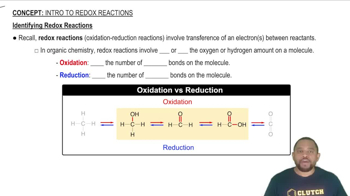
Identifying Redox Reactions
Oxidizing and Reducing Agents
The oxidizing agent is the substance that gains electrons and is reduced in the process, while the reducing agent is the substance that loses electrons and is oxidized. Understanding these roles helps in identifying which reactants facilitate the electron transfer in a redox reaction, thus clarifying the overall process.
Video consigliato:
Percorso guidato
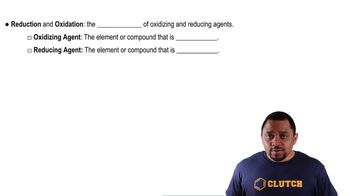
Oxidizing and Reducing Agents
Half-Reaction Method
The half-reaction method is a technique used to analyze redox reactions by separating the oxidation and reduction processes into two half-reactions. This method allows for a clearer understanding of electron transfer and helps in balancing the overall reaction, making it easier to identify the oxidizing and reducing agents.
Video consigliato:
Percorso guidato
Method 1 of Radioactive Half-Life
Pratica correlata
Domanda del libro di testo
1345
views
1
rank
Domanda del libro di testo
Determine whether each reaction is a redox reaction. For each redox reaction, identify the oxidizing agent and the reducing agent. c. Pb(NO3)2(aq) + Na2SO4(aq) → PbSO4(s) + 2 NaNO3(aq) d. HBr(aq) + KOH(aq) → H2O(l) + KBr(aq)
918
views
Domanda del libro di testo
What is the oxidation state of Cr in each compound? b. CrO3
604
views
Domanda del libro di testo
What is the oxidation state of Cr in each compound? c. Cr2O3
607
views
Domanda del libro di testo
Determine whether each reaction is a redox reaction. For each redox reaction, identify the oxidizing agent and the reducing agent. a. Al(s) + 3 Ag+(aq) → Al3+(aq) + 3 Ag(s) b. SO3(g) + H2O(l) → H2SO4(aq) c. Ba(s) + Cl2(g) → BaCl2(s) d. Mg(s) + Br2(l) → MgBr2(s)
498
views
Domanda del libro di testo
Find the percent by mass of sodium chloride in a 1.12 M NaCl solution. The density of the solution is 1.04 g/mL.