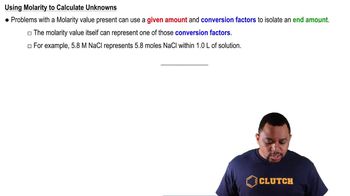
A laboratory procedure calls for making 100.0 mL of a 1.30 M K2SO4 solution. What mass of K2SO4 (in g) is needed?

Ch.5 - Introduction to Solutions and Aqueous Solutions

Tro6th EditionChemistry: A Molecular ApproachISBN: 9780137832217Non è quello che usi tu?Cambia libro di testo
Tutti i libri di testo
Tro 6th Edition
Ch.5 - Introduction to Solutions and Aqueous Solutions
Problema 37
Tro 6th Edition
Ch.5 - Introduction to Solutions and Aqueous Solutions
Problema 37Capitolo 5, Problema 37
If 2.50 L of a 4.80 M MgBr2 solution is diluted to 35.0 L, what is the molarity of the diluted solution?
Guida verificata passo dopo passo1
Identify the initial conditions: initial volume (V1) = 2.50 L and initial molarity (M1) = 4.80 M.
Identify the final volume after dilution: final volume (V2) = 35.0 L.
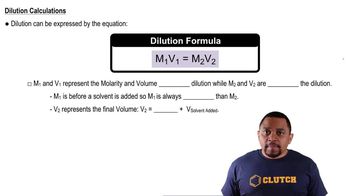
Use the dilution formula: M1 * V1 = M2 * V2, where M2 is the molarity of the diluted solution.
Rearrange the formula to solve for M2: M2 = (M1 * V1) / V2.
Substitute the known values into the equation to find M2.

Risposta video verificata per un problema simile:
Questa soluzione video è stata consigliata dai nostri tutor come utile per risolvere questo problema.
Durata del video:
1mConcetti chiave
Ecco i concetti essenziali che devi comprendere per rispondere correttamente alla domanda.
Molarity
Molarity (M) is a measure of concentration defined as the number of moles of solute per liter of solution. It is expressed in moles per liter (mol/L) and is crucial for understanding how much solute is present in a given volume of solution. In this question, the initial molarity of the MgBr2 solution is given, which is essential for calculating the final concentration after dilution.
Video consigliato:
Percorso guidato
Molarity
Dilution
Dilution is the process of reducing the concentration of a solute in a solution, typically by adding more solvent. The dilution equation, M1V1 = M2V2, relates the initial and final molarities (M1 and M2) and volumes (V1 and V2) of the solution. This concept is key to solving the question, as it allows us to determine the new molarity after the solution is diluted from 2.50 L to 35.0 L.
Video consigliato:
Percorso guidato
Dilution Equation
Conservation of Moles
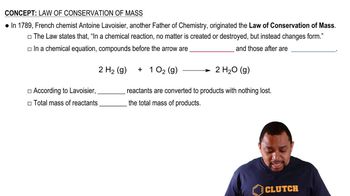
The conservation of moles principle states that the number of moles of solute remains constant before and after dilution, assuming no solute is added or removed. This principle is fundamental in dilution calculations, as it allows us to equate the product of initial molarity and volume to the product of final molarity and volume. Understanding this concept is essential for accurately determining the molarity of the diluted solution.
Video consigliato:
Percorso guidato
Law of Conservation of Mass
Pratica correlata
Domanda del libro di testo
A chemist wants to make 3.00 L of a 0.250 M NaNO3 solution. What mass of NaNO3 (in g) should the chemist use?
1
rank
Domanda del libro di testo
To what volume should you dilute 50.0 mL of a 12 M stock HNO3 solution to obtain a 0.100 M HNO3 solution?
1716
views
Domanda del libro di testo
Consider the reaction: Li2S(aq) + Co(NO3)2(aq) → 2 LiNO3(aq) + CoS(s) What volume of 0.150 M Li2S solution is required to completely react with 225 mL of 0.175 M Co(NO3)2?
2
views
Domanda del libro di testo
If 255 mL of a 2.25 M sucrose solution is diluted to 800.0 rnL, what is the molarity of the diluted solution?
Domanda del libro di testo
What is the minimum amount of 6.0 M H2SO4 necessary to produce 25.0 g of H2(g) according to the reaction between aluminum and sulfuric acid? 2 Al(s) + 3 H2SO4(aq) → Al2(SO4)3(aq) + 3 H2(g)
5198
views
4
rank