Predict the products and write a balanced molecular equation for each reaction. If no reaction occurs, write 'NO REACTION.' d. aqueous ammonium chloride and aqueous calcium hydroxide
Ch.5 - Introduction to Solutions and Aqueous Solutions

Tro6th EditionChemistry: A Molecular ApproachISBN: 9780137832217Non è quello che usi tu?Cambia libro di testo
Tutti i libri di testo
Tro 6th Edition
Ch.5 - Introduction to Solutions and Aqueous Solutions
Problema 87a
Tro 6th Edition
Ch.5 - Introduction to Solutions and Aqueous Solutions
Problema 87aCapitolo 5, Problema 87a
Predict the products and write a balanced molecular equation for each reaction. If no reaction occurs, write 'NO REACTION.' a. HCl(aq) + Hg2(NO3)2(aq) →
Guida verificata passo dopo passo1
Identify the reactants: Hydrochloric acid (HCl) and Mercury(I) nitrate (Hg_2(NO_3)_2).
Determine the possible products by considering the exchange of ions: Hg_2Cl_2 and HNO_3.
Write the unbalanced molecular equation: HCl(aq) + Hg_2(NO_3)_2(aq) → Hg_2Cl_2(s) + HNO_3(aq).
Balance the chemical equation by ensuring the number of atoms of each element is the same on both sides.
Check the solubility of the products: Hg_2Cl_2 is insoluble, confirming the formation of a precipitate.

Risposta video verificata per un problema simile:
Questa soluzione video è stata consigliata dai nostri tutor come utile per risolvere questo problema.
Durata del video:
3mConcetti chiave
Ecco i concetti essenziali che devi comprendere per rispondere correttamente alla domanda.
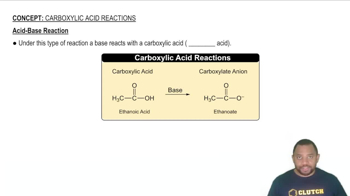
Acid-Base Reactions
Acid-base reactions involve the transfer of protons (H+) between reactants. In this case, hydrochloric acid (HCl) acts as an acid, donating a proton, while the mercury(II) nitrate (Hg2(NO3)2) can act as a base. Understanding the nature of these reactants is crucial for predicting the products of the reaction.
Video consigliato:
Percorso guidato
Acid-Base Reaction
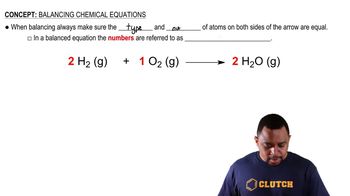
Balancing Chemical Equations
Balancing chemical equations is essential to ensure that the law of conservation of mass is upheld, meaning the number of atoms of each element must be the same on both sides of the equation. This involves adjusting coefficients in front of compounds to achieve balance, which is a fundamental skill in chemistry.
Video consigliato:
Percorso guidato
Balancing Chemical Equations
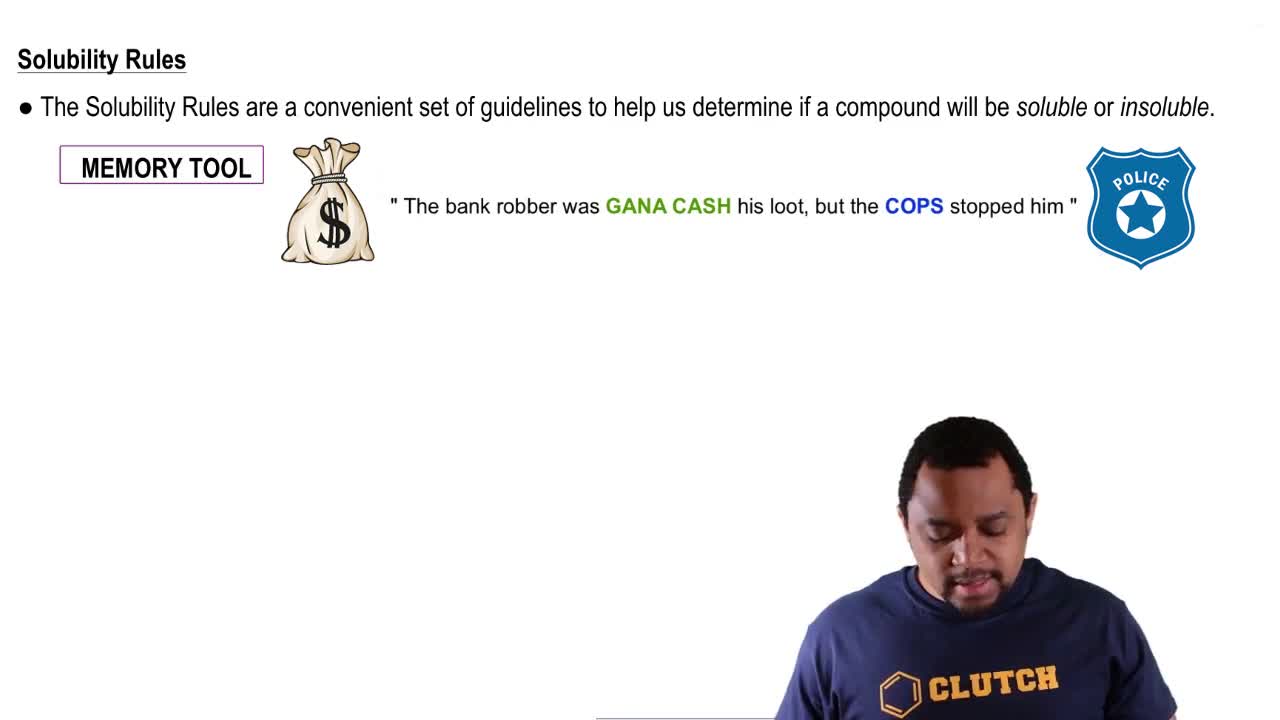
Solubility Rules
Solubility rules help predict whether a reaction will occur in aqueous solutions based on the solubility of the products formed. For instance, if a product is insoluble, it may precipitate out of solution, indicating a reaction has taken place. In this case, knowing the solubility of mercury compounds is key to determining the outcome of the reaction.
Video consigliato:
Percorso guidato
Solubility Rules
Pratica correlata
Domanda del libro di testo
723
views
Domanda del libro di testo
Predict the products and write a balanced molecular equation for each reaction. If no reaction occurs, write 'NO REACTION.' c. liquid pentanol (C5H12O) and gaseous oxygen
938
views
Domanda del libro di testo
Determine whether each reaction is a redox reaction. For each redox reaction, identify the oxidizing agent and the reducing agent. a. Al(s) + 3 Ag+(aq) → Al3+(aq) + 3 Ag(s) b. SO3(g) + H2O(l) → H2SO4(aq) c. Ba(s) + Cl2(g) → BaCl2(s) d. Mg(s) + Br2(l) → MgBr2(s)
498
views
Domanda del libro di testo
Find the percent by mass of sodium chloride in a 1.12 M NaCl solution. The density of the solution is 1.04 g/mL.
Domanda del libro di testo
Predict the products and write a balanced molecular equation for each reaction. If no reaction occurs, write 'NO REACTION.' b. Cr(NO3)3(aq) + LiOH(aq) →
1424
views