
Ch.6 - Gases
Tro - Chemistry: A Molecular Approach 6th Edition
Tro6th EditionChemistry: A Molecular ApproachISBN: 9780137832217Non è quello che usi tu?Cambia libro di testo
Capitolo 6, Problema 72

A 275-mL flask contains pure helium at a pressure of 752 torr. A second flask with a volume of 475 mL contains pure argon at a pressure of 722 torr. If we connect the two flasks through a stopcock and we open the stopcock, what is the partial pressure of argon?

Guida verificata passo dopo passo
1
Convert the pressure of argon from torr to atm if necessary, using the conversion factor: 1 atm = 760 torr.
Calculate the initial moles of argon using the ideal gas law: \( PV = nRT \), where \( P \) is the pressure, \( V \) is the volume, \( n \) is the number of moles, \( R \) is the ideal gas constant, and \( T \) is the temperature in Kelvin. Assume the temperature is constant and the same for both gases.
Determine the total volume after the stopcock is opened by adding the volumes of the two flasks: \( V_{\text{total}} = V_{\text{flask 1}} + V_{\text{flask 2}} \).
Use the ideal gas law again to find the new partial pressure of argon after the stopcock is opened, using the total volume and the initial moles of argon calculated earlier.
The partial pressure of argon is the pressure exerted by argon alone in the combined volume, calculated using the formula: \( P_{\text{argon}} = \frac{nRT}{V_{\text{total}}} \).

Risposta video verificata per un problema simile:

Questa soluzione video è stata consigliata dai nostri tutor come utile per risolvere questo problema.
Durata del video:
3m

Concetti chiave

Ecco i concetti essenziali che devi comprendere per rispondere correttamente alla domanda.

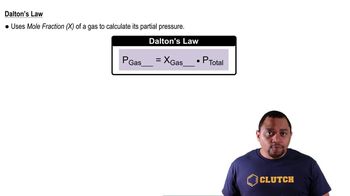
Dalton's Law of Partial Pressures

Dalton's Law states that in a mixture of gases, the total pressure exerted is equal to the sum of the partial pressures of each individual gas. This principle allows us to calculate the pressure of a specific gas in a mixture by considering its contribution to the total pressure, which is essential for solving problems involving multiple gases.
Video consigliato:
Percorso guidato
00:27
Dalton's Law and Partial Pressure

Gas Laws and Volume Relationships

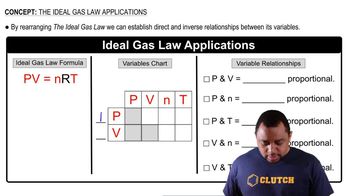
Understanding the relationships between pressure, volume, and temperature of gases is crucial. According to Boyle's Law, for a given amount of gas at constant temperature, the pressure of a gas is inversely proportional to its volume. This concept helps in determining how the pressures of gases change when they are allowed to mix in different volumes.
Video consigliato:
Percorso guidato
04:09
Ideal Gas Law Relationships

Ideal Gas Behavior

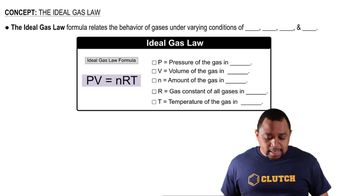
The ideal gas law (PV=nRT) describes the behavior of an ideal gas, where P is pressure, V is volume, n is the number of moles, R is the ideal gas constant, and T is temperature. While real gases may deviate from this behavior under certain conditions, the ideal gas law provides a foundational understanding for calculating pressures and volumes in gas mixtures, which is relevant for this question.
Video consigliato:
Percorso guidato
01:15
Ideal Gas Law Formula
Pratica correlata
Domanda del libro di testo

The hydrogen gas formed in a chemical reaction is collected over water at 30.0 °C at a total pressure of 732 mmHg. What is the partial pressure of the hydrogen gas collected in this way? If the total volume of gas collected is 722 mL, what mass of hydrogen gas is collected?

4586
views
1
comments
Domanda del libro di testo

A gas mixture contains each of the following gases at the indicated partial pressures: N2, 111 torr; O2, 213 torr; and He, 102 torr. What is the total pressure of the mixture? What mass of each gas is present in a 1.55-L sample of this mixture at 25.0°C?

3
views
Domanda del libro di testo

A gas mixture contains 1.05 g N2 and 1.35 g O2 in a 1.35-L container at 15°C. Calculate the mole fraction and partial pressure of each component in the gas mixture.

2
views
Domanda del libro di testo

What is the mole fraction of oxygen gas in air (see Table 6.3)? What volume of air contains 20.0 g of oxygen gas at 273 K and 1.00 atm?

2
views
Domanda del libro di testo

A 1.20-g sample of dry ice is added to a 755 mL flask containing nitrogen gas at a temperature of 25.0 °C and a pressure of 725 mmHg. The dry ice sublimes (converts from solid to gas), and the mixture returns to 25.0 °C. What is the total pressure in the flask?

2978
views
Domanda del libro di testo

A gas mixture with a total pressure of 745 mmHg contains each of the following gases at the indicated partial pressures: CO2, 112 mmHg; Ar, 225 mmHg; and O2, 114 mmHg. The mixture also contains helium gas. What is the partial pressure of the helium gas? What mass of helium gas is present in a 12.0-L sample of this mixture at 273 K?

1
views