
Ch.6 - Gases
Tro - Chemistry: A Molecular Approach 6th Edition
Tro6th EditionChemistry: A Molecular ApproachISBN: 9780137832217Non è quello che usi tu?Cambia libro di testo
Capitolo 6, Problema 84

Lithium reacts with nitrogen gas according to the reaction: 6 Li(s) + N2(g) → 2 Li3N(s) What mass of lithium (in g) reacts completely with 58.5 mL of N2 gas at STP?

Guida verificata passo dopo passo
1
Identify the balanced chemical equation: \(6 \text{ Li(s)} + \text{N}_2(\text{g}) \rightarrow 2 \text{ Li}_3\text{N(s)}\).
Determine the molar volume of a gas at STP, which is 22.4 L/mol.
Convert the volume of \(\text{N}_2\) gas from mL to L: \(58.5 \text{ mL} = 0.0585 \text{ L}\).
Calculate the moles of \(\text{N}_2\) gas using the molar volume: \(\text{moles of } \text{N}_2 = \frac{0.0585 \text{ L}}{22.4 \text{ L/mol}}\).
Use the stoichiometry of the balanced equation to find the moles of \(\text{Li}\) needed, then convert moles of \(\text{Li}\) to grams using its molar mass (6.94 g/mol).

Risposta video verificata per un problema simile:

Questa soluzione video è stata consigliata dai nostri tutor come utile per risolvere questo problema.
Durata del video:
2m

Concetti chiave

Ecco i concetti essenziali che devi comprendere per rispondere correttamente alla domanda.

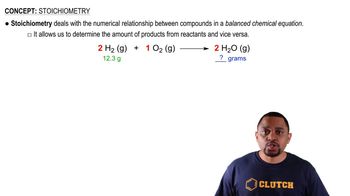
Stoichiometry

Stoichiometry is the calculation of reactants and products in chemical reactions based on the balanced equation. It allows us to determine the proportions of substances involved in a reaction, which is essential for solving problems related to mass and volume of reactants and products.
Video consigliato:
Percorso guidato
01:16
Stoichiometry Concept

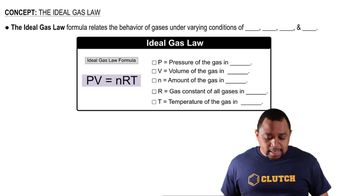
Ideal Gas Law

The Ideal Gas Law relates the pressure, volume, temperature, and number of moles of a gas through the equation PV = nRT. At standard temperature and pressure (STP), one mole of an ideal gas occupies 22.4 liters, which is crucial for converting the volume of nitrogen gas into moles for stoichiometric calculations.
Video consigliato:
Percorso guidato
01:15
Ideal Gas Law Formula

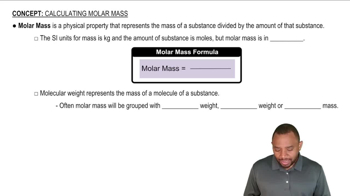
Molar Mass

Molar mass is the mass of one mole of a substance, typically expressed in grams per mole (g/mol). Knowing the molar mass of lithium allows us to convert the number of moles of lithium required for the reaction into grams, facilitating the calculation of the mass that reacts with a given volume of nitrogen gas.
Video consigliato:
Percorso guidato
02:11
Molar Mass Concept
Pratica correlata
Domanda del libro di testo

CH3OH can be synthesized by the reaction: CO(g) + 2 H2(g) → CH3OH( g) What volume of H2 gas (in L), at 748 mmHg and 86 °C, is required to synthesize 25.8 g CH3OH? How many liters of CO gas, measured under the same conditions, are required?

1778
views
1
comments
Domanda del libro di testo

Automobile air bags inflate following a serious impact. The impact triggers the chemical reaction: 2 NaN3(s) → 2 Na(s) + 3 N2(g) If an automobile air bag has a volume of 11.8 L, what mass of NaN3 (in g) is required to fully inflate the air bag upon impact? Assume STP conditions.

6100
views
2
rank
3
comments
Domanda del libro di testo

Ozone is depleted in the stratosphere by chlorine from CF3Cl according to this set of equations:

CF3Cl + UV light → CF3 + Cl

Cl + O3 → ClO + O2

O3 + UV light → O2 + O

ClO + O → Cl + O2

What total volume of ozone at a pressure of 25.0 mmHg and a temperature of 225 K is destroyed when all of the chlorine from 15.0 g of CF3Cl goes through 10 cycles of the given reactions?

1494
views
Domanda del libro di testo

Hydrogen gas (a potential future fuel) can be formed by the reaction of methane with water according to the equation: CH4(g) + H2O(g) → CO(g) + 3 H2(g) In a particular reaction, 25.5 L of methane gas (measured at a pressure of 732 torr and a temperature of 25 °C) mixes with 22.8 L of water vapor (measured at a pressure of 702 torr and a temperature of 125 °C). The reaction produces 26.2 L of hydrogen gas at STP. What is the percent yield of the reaction?

5161
views
Domanda del libro di testo

Chlorine gas reacts with fluorine gas to form chlorine trifluoride. Cl2(g) + 3 F2(g) → 2 ClF3(g) A 2.00-L reaction vessel, initially at 298 K, contains chlorine gas at a partial pressure of 337 mmHg and fluorine gas at a partial pressure of 729 mmHg. Identify the limiting reactant. Determine the theoretical yield of ClF3 in grams.

5162
views
1
rank
Domanda del libro di testo

Oxygen gas reacts with powdered aluminum according to the reaction: 4 Al(s) + 3 O2(g) → 2 Al2O3(s) What volume of O2 gas (in L), measured at 782 mmHg and 25 °C, completely reacts with 53.2 g Al?

1567
views