Ch.7 - Thermochemistry
Tro - Chemistry: A Molecular Approach 6th Edition
Tro6th EditionChemistry: A Molecular ApproachISBN: 9780137832217Non è quello che usi tu?Cambia libro di testo
Capitolo 7, Problema 109

A 25.5-g aluminum block is warmed to 65.4 °C and plunged into an insulated beaker containing 55.2 g water initially at 22.2 °C. The aluminum and the water are allowed to come to thermal equilibrium. Assuming that no heat is lost, what is the final temperature of the water and aluminum?

Guida verificata passo dopo passo
1
Identify the specific heat capacities for aluminum and water. The specific heat capacity of aluminum is approximately 0.900 J/g°C, and for water, it is approximately 4.184 J/g°C.
Set up the heat transfer equation assuming no heat loss to the surroundings. The heat lost by the aluminum block will equal the heat gained by the water: \(m_{Al} \times c_{Al} \times (T_f - T_{i,Al}) = m_{H_2O} \times c_{H_2O} \times (T_f - T_{i,H_2O})\), where \(m\) is mass, \(c\) is specific heat capacity, \(T_f\) is the final temperature, and \(T_i\) is the initial temperature.
Plug in the known values: mass of aluminum (25.5 g), initial temperature of aluminum (65.4 °C), mass of water (55.2 g), initial temperature of water (22.2 °C), and the specific heat capacities.
Solve the equation for the final temperature \(T_f\). This involves combining like terms and isolating \(T_f\) on one side of the equation.
Check the physical plausibility of your answer, ensuring that the final temperature is between the initial temperatures of the aluminum and the water, as heat flows from the warmer substance to the cooler one until thermal equilibrium is reached.

Risposta video verificata per un problema simile:

Questa soluzione video è stata consigliata dai nostri tutor come utile per risolvere questo problema.
Durata del video:
6m

Concetti chiave

Ecco i concetti essenziali che devi comprendere per rispondere correttamente alla domanda.

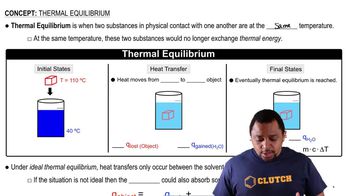
Thermal Equilibrium

Thermal equilibrium occurs when two substances at different temperatures come into contact and exchange heat until they reach the same temperature. In this scenario, the aluminum block and water will transfer heat between each other until they stabilize at a common final temperature, which is essential for solving the problem.
Video consigliato:
Percorso guidato
02:35
Thermal Equilibrium

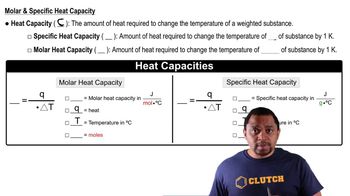
Specific Heat Capacity

Specific heat capacity is the amount of heat required to raise the temperature of one gram of a substance by one degree Celsius. Each material has a unique specific heat capacity, which influences how much heat it can absorb or release. For this problem, the specific heat capacities of aluminum and water will be crucial in calculating the final temperature after heat exchange.
Video consigliato:

Heat Transfer Equation

The heat transfer equation, often expressed as Q = mcΔT, relates the heat gained or lost (Q) to the mass (m), specific heat capacity (c), and change in temperature (ΔT) of a substance. In this case, the heat lost by the aluminum block will equal the heat gained by the water, allowing us to set up an equation to find the final equilibrium temperature.
Video consigliato:
Pratica correlata
Domanda del libro di testo

If 50.0 mL of ethanol (density = 0.789 g/mL) initially at 7.0 °C is mixed with 50.0 mL of water (density = 1.0 g/mL) initially at 28.4 °C in an insulated beaker, and assuming that no heat is lost, what is the final temperature of the mixture?

3704
views
1
comments
Domanda del libro di testo

Use standard enthalpies of formation to calculate the standard change in enthalpy for the melting of ice. (The ΔH°f for H2O(s) is –291.8 kJ/mol.) Use this value to calculate the mass of ice required to cool 355 mL of a beverage from room temperature (25.0 °C) to 0.0 °C. Assume that the specific heat capacity and density of the beverage are the same as those of water.

4255
views
1
rank
Domanda del libro di testo

Dry ice is solid carbon dioxide. Instead of melting, solid carbon dioxide sublimes according to the equation: CO2(s) → CO2(g) ◀ When carbon dioxide sublimes, the gaseous CO2 is cold enough to cause water vapor in the air to condense, forming fog. When dry ice is added to warm water, heat from the water causes the dry ice to sublime more quickly. The evaporating carbon dioxide produces a dense fog often used to create special effects. In a simple dry ice fog machine, dry ice is added to warm water in a Styrofoam cooler. The dry ice produces fog until it evaporates away, or until the water gets too cold to sublime the dry ice quickly enough. Suppose that a small Styrofoam cooler holds 15.0 L of water heated to 85 °C. Use standard enthalpies of formation to calculate the change in enthalpy for dry ice sublimation, and calculate the mass of dry ice that should be added to the water so that the dry ice completely sublimes away when the water reaches 25 °C. Assume no heat loss to the surroundings. (The ΔH°f for CO2(s) is –427.4 kJ/mol.)

1761
views
Domanda del libro di testo

Palmitic acid (C16H32O2) is a dietary fat found in beef and butter. The caloric content of palmitic acid is typical of fats in general. Write a balanced equation for the complete combustion of palmitic acid and calculate the standard enthalpy of combustion. What is the caloric content of palmitic acid in Cal/g? The standard enthalpy of formation of palmitic acid is -208 kJ/mol and that of sucrose is -2226.1 kJ/mol. [Use H2O(l) in the balanced chemical equations because the metabolism of these compounds produces liquid water.]

1902
views
Domanda del libro di testo

Use standard enthalpies of formation to calculate the standard change in enthalpy for the melting of ice. (The ΔH°f for H2O(s) is –291.8 kJ/mol.)

1855
views