
Domanda del libro di testo
The change in internal energy for the combustion of 1.0 mol of octane at a pressure of 1.0 atm is 5084.3 kJ. If the change in enthalpy is 5074.1 kJ, how much work is done during the combustion?
2279
views
 Guida verificata passo dopo passo
 1:48
1:48
 02:34
02:34 01:46
01:46The change in internal energy for the combustion of 1.0 mol of octane at a pressure of 1.0 atm is 5084.3 kJ. If the change in enthalpy is 5074.1 kJ, how much work is done during the combustion?
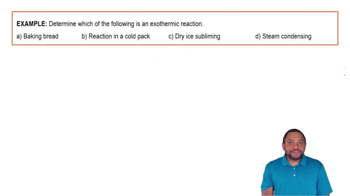
Determine whether each process is exothermic or endothermic and indicate the sign of ΔH. a. natural gas burning on a stove b. isopropyl alcohol evaporating from skin c. water condensing from steam Determine whether each of the following is exothermic or endothermic.
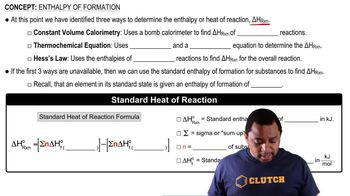
When 1 mol of a fuel burns at constant pressure, it produces 3452 kJ of heat and does 11 kJ of work. What are ΔE and ΔH for the combustion of the fuel?
Nitromethane (CH3NO2) burns in air to produce significant amounts of heat. 2 CH3NO2(l ) + 32 O2( g)¡2 CO2( g) + 3 H2O(l ) + N2( g) ΔH °rxn = -1418 kJ How much heat is produced by the complete reaction of 10.47 kg of nitromethane?
Determine whether each process is exothermic or endothermic and indicate the sign of ΔH. a. dry ice evaporating b. a sparkler burning c. the reaction that occurs in a chemical cold pack used to ice athletic injuries
What mass of natural gas (CH4) must burn to emit 352 kJ of heat? CH4( g) + 2 O2( g)¡CO2( g) + 2 H2O( g) ΔH °rxn = -802.3 kJ