
Ch.7 - Thermochemistry
Tro - Chemistry: A Molecular Approach 6th Edition
Tro6th EditionChemistry: A Molecular ApproachISBN: 9780137832217Non è quello che usi tu?Cambia libro di testo
Capitolo 7, Problema 75

Exactly 1.5 g of a fuel burns under conditions of constant pressure and then again under conditions of constant volume. In measurement A the reaction produces 25.9 kJ of heat, and in measurement B the reaction produces 23.3 kJ of heat. Which measurement (A or B) corresponds to conditions of constant pressure? Explain.

Guida verificata passo dopo passo
1
Identify the two types of thermodynamic conditions: constant pressure and constant volume.
Recall that under constant pressure, the heat exchanged is equal to the change in enthalpy (ΔH), while under constant volume, the heat exchanged is equal to the change in internal energy (ΔU).
Understand that for exothermic reactions, the enthalpy change (ΔH) is typically greater than the change in internal energy (ΔU) because it includes work done by the system (expansion work).
Compare the heat values given: 25.9 kJ and 23.3 kJ. The larger value (25.9 kJ) is likely to correspond to the enthalpy change (ΔH) under constant pressure.
Conclude that measurement A, which produces 25.9 kJ of heat, corresponds to conditions of constant pressure.

Risposta video verificata per un problema simile:

Questa soluzione video è stata consigliata dai nostri tutor come utile per risolvere questo problema.
Durata del video:
2m

Concetti chiave

Ecco i concetti essenziali che devi comprendere per rispondere correttamente alla domanda.

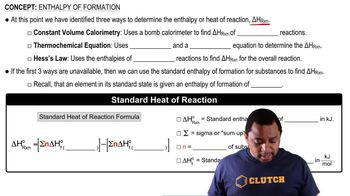
Enthalpy and Heat Transfer

Enthalpy is a thermodynamic property that reflects the total heat content of a system at constant pressure. When a reaction occurs at constant pressure, the heat released or absorbed is equal to the change in enthalpy (ΔH). This means that the heat measured in such conditions directly corresponds to the enthalpy change of the reaction.
Video consigliato:
Percorso guidato
02:34
Enthalpy of Formation

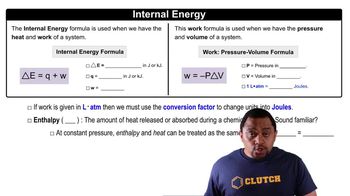
Internal Energy and Work

Internal energy is the total energy contained within a system, including kinetic and potential energies of the particles. When a reaction occurs at constant volume, any heat exchanged is related to the change in internal energy (ΔU), and work done by the system is zero. Thus, the heat measured in this scenario reflects changes in internal energy rather than enthalpy.
Video consigliato:
Percorso guidato
01:51
Internal Energy

First Law of Thermodynamics

The First Law of Thermodynamics states that energy cannot be created or destroyed, only transformed. In the context of chemical reactions, this means that the heat produced or absorbed during a reaction can be accounted for by changes in internal energy and work done. Understanding this law helps differentiate between heat measurements at constant pressure and constant volume.
Video consigliato:
Percorso guidato
01:18
First Law of Thermodynamics
Pratica correlata
Domanda del libro di testo

When 1.03 g of biphenyl (C12H10) undergoes combustion in a bomb calorimeter, the temperature rises from 24.2 °C to 2931.4 °C. Find ΔErxn for the combustion of biphenyl in kJ>mol biphenyl. The heat capacity of the bomb calorimeter, determined in a separate experiment, is 5.86 kJ/°C.

Domanda del libro di testo

Two substances, A and B, initially at different temperatures, come into contact and reach thermal equilibrium. The mass of substance A is 6.15 g and its initial temperature is 20.5 °C. The mass of substance B is 25.2 g and its initial temperature is 52.7 °C. The final temperature of both substances at thermal equilibrium is 46.7 °C. If the specific heat capacity of substance B is 1.17 J/g•°C, what is the specific heat capacity of substance A?

3164
views
1
rank
Domanda del libro di testo

A 2.85-g lead weight, initially at 10.3 °C, is submerged in 7.55 g of water at 52.3 °C in an insulated container. What is the final temperature of both substances at thermal equilibrium?

2970
views
4
rank
1
comments
Domanda del libro di testo

A 31.1-g wafer of pure gold, initially at 69.3 °C, is submerged into 64.2 g of water at 27.8 °C in an insulated container. What is the final temperature of both substances at thermal equilibrium?

4111
views
4
rank
2
comments
Domanda del libro di testo

Zinc metal reacts with hydrochloric acid according to the balanced equation: Zn(s) + 2 HCl(aq) → ZnCl2(aq) + H2(g) When 0.103 g of Zn(s) is combined with enough HCl to make 50.0 mL of solution in a coffee-cup calorimeter, all of the zinc reacts, raising the temperature of the solution from 22.5 °C to 23.7 °C. Find ΔHrxn for this reaction as written. (Use 1.0 g/mL for the density of the solution and 4.18 J/g•°C as the specific heat capacity.)

27264
views