Ch.7 - Thermochemistry
Tro - Chemistry: A Molecular Approach 6th Edition
Tro6th EditionChemistry: A Molecular ApproachISBN: 9780137832217Non è quello che usi tu?Cambia libro di testo
Capitolo 7, Problema 114

Under certain nonstandard conditions, oxidation by O2(g) of 1 mol of SO2(g) to SO3(g) absorbs 89.5 kJ. The enthalpy of formation of SO3(g) is –204.2 kJ under these conditions. Find the enthalpy of formation of SO2(g).

Guida verificata passo dopo passo
1
Identify the given information: the enthalpy change for the reaction \( \text{SO}_2(g) + \frac{1}{2} \text{O}_2(g) \rightarrow \text{SO}_3(g) \) is +89.5 kJ, and the enthalpy of formation of \( \text{SO}_3(g) \) is -204.2 kJ.
Recall that the enthalpy change for a reaction (\( \Delta H_{\text{rxn}} \)) can be calculated using the enthalpies of formation: \( \Delta H_{\text{rxn}} = \Delta H_f(\text{products}) - \Delta H_f(\text{reactants}) \).
Set up the equation for the enthalpy change of the reaction: \( \Delta H_{\text{rxn}} = \Delta H_f(\text{SO}_3(g)) - \left( \Delta H_f(\text{SO}_2(g)) + \frac{1}{2} \Delta H_f(\text{O}_2(g)) \right) \).
Since the enthalpy of formation of \( \text{O}_2(g) \) is 0 (as it is in its standard state), simplify the equation to: \( 89.5 = -204.2 - \Delta H_f(\text{SO}_2(g)) \).
Solve for \( \Delta H_f(\text{SO}_2(g)) \) by rearranging the equation: \( \Delta H_f(\text{SO}_2(g)) = -204.2 - 89.5 \).

Risposta video verificata per un problema simile:

Questa soluzione video è stata consigliata dai nostri tutor come utile per risolvere questo problema.

Concetti chiave

Ecco i concetti essenziali che devi comprendere per rispondere correttamente alla domanda.

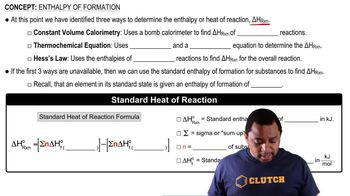
Enthalpy of Formation

The enthalpy of formation is the change in enthalpy when one mole of a compound is formed from its elements in their standard states. It is a crucial concept in thermodynamics, allowing chemists to understand the energy changes associated with chemical reactions. For example, the enthalpy of formation of SO3 indicates how much energy is released or absorbed when SO3 is formed from sulfur and oxygen.
Video consigliato:
Percorso guidato
02:34
Enthalpy of Formation

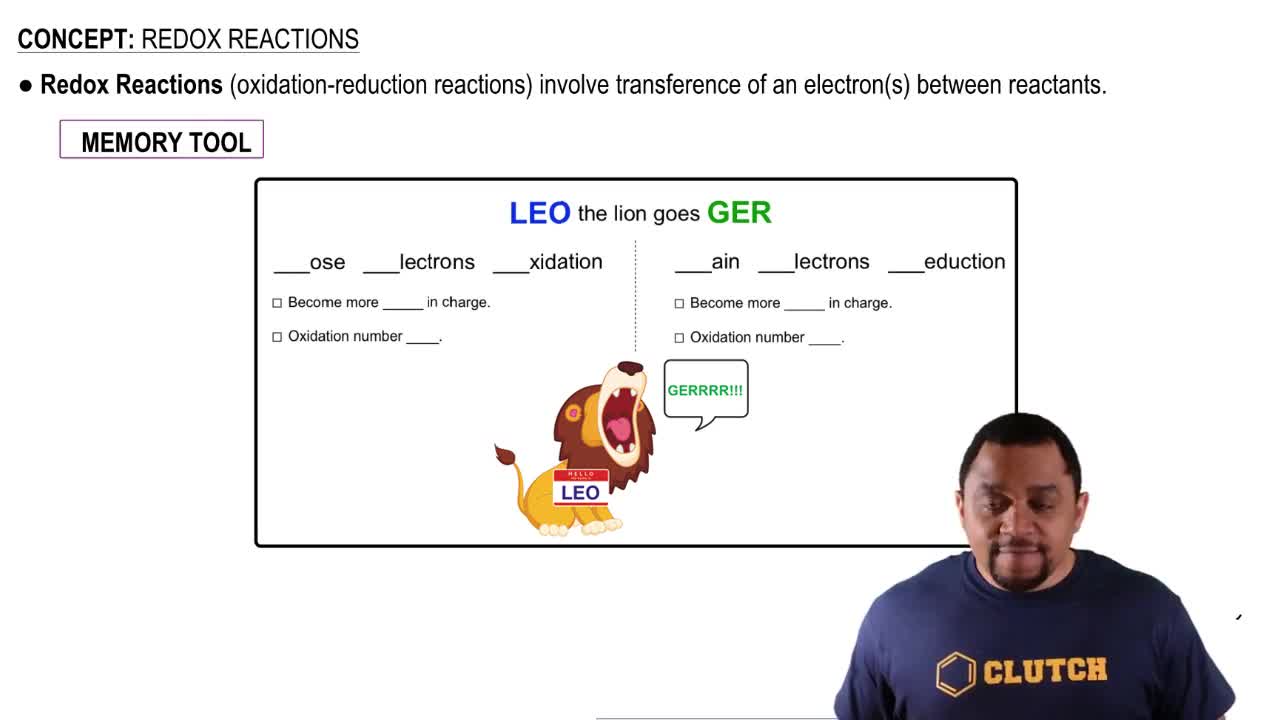
Oxidation-Reduction Reactions

Oxidation-reduction (redox) reactions involve the transfer of electrons between substances, leading to changes in oxidation states. In the given question, the oxidation of SO2 to SO3 involves the loss of electrons by sulfur, which is oxidized. Understanding redox reactions is essential for analyzing energy changes and determining the enthalpy associated with these processes.
Video consigliato:
Percorso guidato
01:53
Oxidation and Reduction Reactions

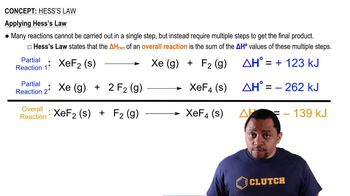
Hess's Law

Hess's Law states that the total enthalpy change for a reaction is the sum of the enthalpy changes for individual steps, regardless of the pathway taken. This principle allows for the calculation of unknown enthalpy changes by using known values. In this case, Hess's Law can be applied to relate the enthalpy of formation of SO2 to the enthalpy changes associated with the oxidation of SO2 to SO3.
Video consigliato: