Ch.8 - The Quantum-Mechanical Model of the Atom
Tro - Chemistry: A Molecular Approach 6th Edition
Tro6th EditionChemistry: A Molecular ApproachISBN: 9780137832217Non è quello che usi tu?Cambia libro di testo
Capitolo 8, Problema 43

Calculate the energy of a photon of each wavelength and state what part of the electromagnetic spectrum is associated with the wavelength.
a. 105 nm
b. 715 nm
c. 2.52 cm

Guida verificata passo dopo passo
1
insert step 1: Understand the relationship between energy and wavelength using the formula: E = \(\frac{hc}{\lambda}\), where E is the energy of the photon, h is Planck's constant (6.626 \(\times\) 10^{-34} \(\text{ J s}\)), c is the speed of light (3.00 \(\times\) 10^8 \(\text{ m/s}\)), and \(\lambda\) is the wavelength.
insert step 2: Convert the given wavelengths into meters for consistency in units. For example, 105 nm = 105 \(\times\) 10^{-9} m, 715 nm = 715 \(\times\) 10^{-9} m, and 2.52 cm = 2.52 \(\times\) 10^{-2} m.
insert step 3: Substitute the converted wavelength values into the energy formula for each case to calculate the energy of the photon.
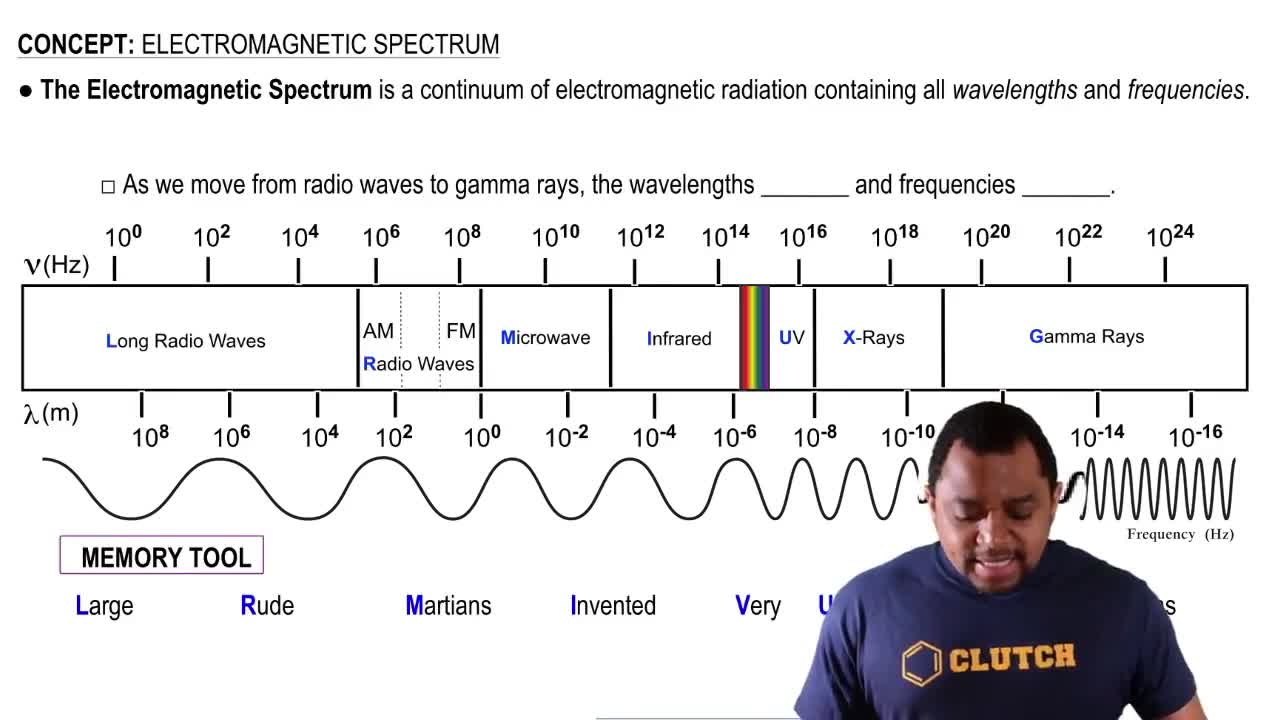
insert step 4: Identify the part of the electromagnetic spectrum each wavelength corresponds to. For instance, 105 nm is in the ultraviolet range, 715 nm is in the visible range (red light), and 2.52 cm is in the microwave range.
insert step 5: Summarize the findings by stating the energy calculated for each wavelength and the corresponding part of the electromagnetic spectrum.

Risposta video verificata per un problema simile:

Questa soluzione video è stata consigliata dai nostri tutor come utile per risolvere questo problema.
Durata del video:
2m

Concetti chiave

Ecco i concetti essenziali che devi comprendere per rispondere correttamente alla domanda.

Photon Energy Calculation

The energy of a photon can be calculated using the equation E = hc/λ, where E is the energy, h is Planck's constant (6.626 x 10^-34 J·s), c is the speed of light (3.00 x 10^8 m/s), and λ is the wavelength in meters. This relationship shows that energy is inversely proportional to wavelength; shorter wavelengths correspond to higher energy photons.
Video consigliato:
Percorso guidato
00:41
Moles and Photon Energy

Electromagnetic Spectrum

The electromagnetic spectrum encompasses all types of electromagnetic radiation, arranged by wavelength or frequency. It includes gamma rays, X-rays, ultraviolet light, visible light, infrared radiation, microwaves, and radio waves. Each region of the spectrum has distinct properties and applications, with visible light being the only part detectable by the human eye.
Video consigliato:
Percorso guidato
02:53
Electromagnetic Spectrum

Wavelength Conversion

To calculate photon energy accurately, wavelengths must be in meters. For example, to convert nanometers (nm) to meters, divide by 1 billion (1 nm = 1 x 10^-9 m), and for centimeters (cm), divide by 100 (1 cm = 0.01 m). This conversion is essential for applying the photon energy formula correctly and identifying the corresponding part of the electromagnetic spectrum.
Video consigliato:
Percorso guidato
01:56
Conversion Factors