Ch.8 - The Quantum-Mechanical Model of the Atom
Tro - Chemistry: A Molecular Approach 6th Edition
Tro6th EditionChemistry: A Molecular ApproachISBN: 9780137832217Non è quello che usi tu?Cambia libro di testo
Capitolo 8, Problema 75

Calculate the wavelength of the light emitted when an electron in a hydrogen atom makes each transition and indicate the region of the electromagnetic spectrum (infrared, visible, ultraviolet, etc.) where the light is found. a. n = 2 → n = 1 b. n = 3 → n = 1 c. n = 4 → n = 2 d. n = 5 → n = 2

Guida verificata passo dopo passo
1
Identify the formula to calculate the wavelength of light emitted during an electron transition in a hydrogen atom: \( \frac{1}{\lambda} = R_H \left( \frac{1}{n_1^2} - \frac{1}{n_2^2} \right) \), where \( R_H \) is the Rydberg constant (1.097 \(\times\) 10^7 \(\text{ m}\)^{-1}), \( n_1 \) is the lower energy level, and \( n_2 \) is the higher energy level.
For each transition, substitute the given values of \( n_1 \) and \( n_2 \) into the formula to find \( \frac{1}{\lambda} \).
Calculate \( \lambda \) by taking the reciprocal of \( \frac{1}{\lambda} \).
Convert the wavelength from meters to nanometers by multiplying by \( 10^9 \) (since 1 m = 10^9 nm).
Determine the region of the electromagnetic spectrum by comparing the calculated wavelength to known ranges: infrared (> 700 nm), visible (400-700 nm), ultraviolet (< 400 nm).

Risposta video verificata per un problema simile:

Questa soluzione video è stata consigliata dai nostri tutor come utile per risolvere questo problema.
Durata del video:
15m

Concetti chiave

Ecco i concetti essenziali che devi comprendere per rispondere correttamente alla domanda.

Energy Levels in Hydrogen Atom

In a hydrogen atom, electrons occupy specific energy levels, denoted by quantum numbers (n). When an electron transitions between these levels, it either absorbs or emits energy in the form of light. The energy difference between the levels determines the wavelength of the emitted light, which can be calculated using the Rydberg formula.
Video consigliato:
Percorso guidato
01:22
Hydrogenation Reactions

Wavelength and Frequency Relationship

The wavelength of light is inversely related to its frequency, as described by the equation c = λν, where c is the speed of light, λ is the wavelength, and ν is the frequency. This relationship is crucial for determining the wavelength of light emitted during electron transitions in the hydrogen atom, as the energy of the emitted photon can be calculated from the frequency.
Video consigliato:
Percorso guidato
00:31
Frequency-Wavelength Relationship

Regions of the Electromagnetic Spectrum

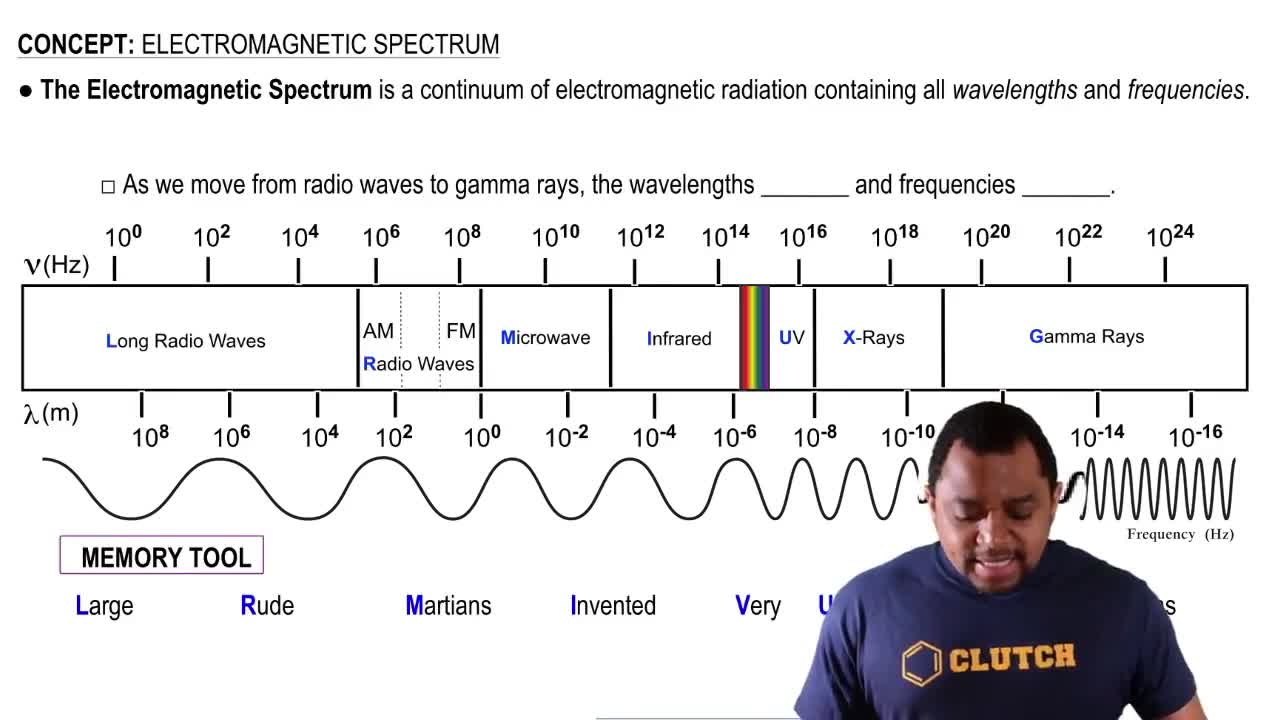
The electromagnetic spectrum is divided into various regions based on wavelength and frequency, including infrared, visible, and ultraviolet light. The wavelength calculated from electron transitions in a hydrogen atom will fall into one of these regions, which helps in identifying the type of light emitted. For example, transitions from higher energy levels often result in ultraviolet light, while lower energy transitions may emit visible or infrared light.
Video consigliato:
Percorso guidato
02:53
Electromagnetic Spectrum