
Ch.8 - The Quantum-Mechanical Model of the Atom
Tro - Chemistry: A Molecular Approach 6th Edition
Tro6th EditionChemistry: A Molecular ApproachISBN: 9780137832217Non è quello che usi tu?Cambia libro di testo
Capitolo 8, Problema 90

Suppose that, in an alternate universe, the possible values of ml are the integer values including 0 ranging from -l -1 to l +1 (instead of simply -l to +l). How many orbitals exist in each sublevel? a. s sublevel b. p sublevel c. d sublevel

Guida verificata passo dopo passo
1
1. In this alternate universe, the magnetic quantum number (ml) ranges from -l -1 to l +1. This means that for each sublevel, there are 2l + 3 possible values of ml, which correspond to the number of orbitals in each sublevel.
2. For the s sublevel, the angular quantum number (l) is 0. So, the number of orbitals is 2*0 + 3 = 3.
3. For the p sublevel, the angular quantum number (l) is 1. So, the number of orbitals is 2*1 + 3 = 5.
4. For the d sublevel, the angular quantum number (l) is 2. So, the number of orbitals is 2*2 + 3 = 7.
5. Therefore, in this alternate universe, there are 3 orbitals in the s sublevel, 5 orbitals in the p sublevel, and 7 orbitals in the d sublevel.

Risposta video verificata per un problema simile:

Questa soluzione video è stata consigliata dai nostri tutor come utile per risolvere questo problema.
Durata del video:
1m

Concetti chiave

Ecco i concetti essenziali che devi comprendere per rispondere correttamente alla domanda.

Quantum Numbers

Quantum numbers are sets of numerical values that describe the unique quantum state of an electron in an atom. The four quantum numbers include the principal quantum number (n), azimuthal quantum number (l), magnetic quantum number (ml), and spin quantum number (ms). Each quantum number provides specific information about the electron's energy level, shape, orientation, and spin, which are essential for understanding electron configurations and orbital shapes.
Video consigliato:
Percorso guidato
02:55
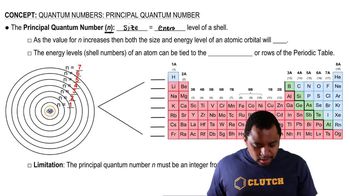
Principal Quantum Number

Sublevels and Orbitals

Sublevels are divisions of principal energy levels (n) in an atom, characterized by the azimuthal quantum number (l). Each sublevel corresponds to a specific type of orbital: s (l=0), p (l=1), d (l=2), and f (l=3). The number of orbitals within a sublevel is determined by the values of the magnetic quantum number (ml), which indicates the orientation of the orbitals in space. In the standard model, s has 1 orbital, p has 3, and d has 5.
Video consigliato:
Percorso guidato
03:06
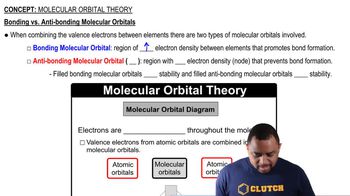
Molecular Orbital Theory

Modified Magnetic Quantum Number

In the given alternate universe scenario, the magnetic quantum number (ml) ranges from -l-1 to l+1, which expands the possible orientations of orbitals. For example, in the s sublevel (l=0), there is still 1 orbital; in the p sublevel (l=1), the range of ml would allow for 3 orbitals; however, in the d sublevel (l=2), the range would now include 5 additional orientations, resulting in a total of 7 orbitals. This modification alters the traditional understanding of orbital availability in each sublevel.
Video consigliato:
Percorso guidato
03:06
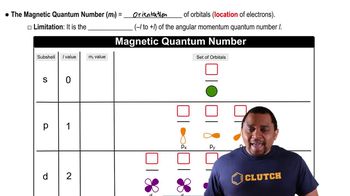
Magnetic Quantum Number