Ch.8 - The Quantum-Mechanical Model of the Atom
Tro - Chemistry: A Molecular Approach 6th Edition
Tro6th EditionChemistry: A Molecular ApproachISBN: 9780137832217Non è quello che usi tu?Cambia libro di testo
Capitolo 8, Problema 51

The resolution limit of a microscope is roughly equal to the wavelength of light used in producing the image. Electron microscopes use an electron beam (in place of photons) to produce much higher resolution images, about 0.20 nm in modern instruments. Assuming that the resolution of an electron microscope is equal to the de Broglie wavelength of the electrons used, to what speed must the electrons be accelerated to obtain a resolution of 0.20 nm?

Guida verificata passo dopo passo
1
Identify the de Broglie wavelength formula: \( \lambda = \frac{h}{mv} \), where \( \lambda \) is the wavelength, \( h \) is Planck's constant, \( m \) is the mass of an electron, and \( v \) is the velocity of the electron.
Rearrange the formula to solve for velocity \( v \): \( v = \frac{h}{m\lambda} \).
Substitute the known values into the equation: Planck's constant \( h = 6.626 \times 10^{-34} \text{ m}^2 \text{ kg/s} \), the mass of an electron \( m = 9.109 \times 10^{-31} \text{ kg} \), and the desired wavelength \( \lambda = 0.20 \text{ nm} = 0.20 \times 10^{-9} \text{ m} \).
Calculate the velocity \( v \) using the substituted values.
Ensure the units are consistent and check the calculation for any possible errors.

Risposta video verificata per un problema simile:

Questa soluzione video è stata consigliata dai nostri tutor come utile per risolvere questo problema.
Durata del video:
1m

Concetti chiave

Ecco i concetti essenziali che devi comprendere per rispondere correttamente alla domanda.

Resolution Limit

The resolution limit of a microscope refers to the smallest distance between two points that can still be distinguished as separate entities. In optical microscopes, this limit is primarily determined by the wavelength of light used; shorter wavelengths allow for higher resolution. In electron microscopy, the resolution can be significantly improved due to the much shorter de Broglie wavelength of electrons compared to visible light.
Video consigliato:
Percorso guidato
01:30
Limiting Reagent Concept

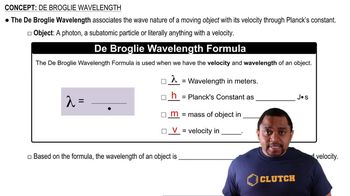
de Broglie Wavelength

The de Broglie wavelength is a concept from quantum mechanics that describes the wave-like behavior of particles, such as electrons. It is given by the formula λ = h/p, where λ is the wavelength, h is Planck's constant, and p is the momentum of the particle. This relationship implies that faster-moving particles have shorter wavelengths, which is crucial for achieving high resolution in electron microscopy.
Video consigliato:
Percorso guidato
00:58
De Broglie Wavelength Formula

Momentum and Speed of Electrons

Momentum (p) is defined as the product of mass (m) and velocity (v) of an object, expressed as p = mv. In the context of electrons in an electron microscope, their speed must be calculated to achieve a specific de Broglie wavelength for desired resolution. By manipulating the speed of the electrons, one can control their momentum and thus their wavelength, allowing for the fine-tuning of the microscope's resolution capabilities.
Video consigliato:
Percorso guidato
00:57
Speed of Light Formula