Ch.8 - The Quantum-Mechanical Model of the Atom
Tro - Chemistry: A Molecular Approach 6th Edition
Tro6th EditionChemistry: A Molecular ApproachISBN: 9780137832217Non è quello che usi tu?Cambia libro di testo
Capitolo 8, Problema 59

Which electron is, on average, closer to the nucleus: an electron in a 2s orbital or an electron in a 3s orbital?

Guida verificata passo dopo passo
1
Understand the concept of atomic orbitals and their energy levels. The principal quantum number, n, indicates the energy level and size of the orbital.
Recognize that the 2s orbital has a principal quantum number of n=2, while the 3s orbital has n=3.
Recall that orbitals with lower principal quantum numbers are generally closer to the nucleus.
Consider the radial distribution of s orbitals, which shows that electrons in lower energy levels (like 2s) are more likely to be found closer to the nucleus than those in higher energy levels (like 3s).
Conclude that, on average, an electron in a 2s orbital is closer to the nucleus than an electron in a 3s orbital due to the lower principal quantum number.

Concetti chiave

Ecco i concetti essenziali che devi comprendere per rispondere correttamente alla domanda.

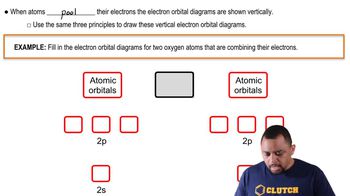
Atomic Orbitals

Atomic orbitals are regions around the nucleus where electrons are likely to be found. They are defined by quantum numbers, which describe the energy level, shape, and orientation of the orbital. The 's' orbitals are spherical, and their size increases with the principal quantum number, meaning that a 3s orbital is larger than a 2s orbital.
Video consigliato:
Percorso guidato
01:51
Atomic Orbitals Example

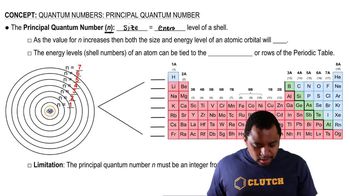
Principal Quantum Number

The principal quantum number (n) indicates the main energy level of an electron in an atom. It can take positive integer values (1, 2, 3, etc.), with higher numbers corresponding to higher energy levels and greater average distances from the nucleus. Therefore, electrons in a 2s orbital (n=2) are generally closer to the nucleus than those in a 3s orbital (n=3).
Video consigliato:
Percorso guidato
02:55
Principal Quantum Number

Electron Shielding

Electron shielding refers to the phenomenon where inner electrons repel outer electrons, reducing the effective nuclear charge felt by the outer electrons. In multi-electron atoms, this effect means that electrons in higher energy levels (like 3s) experience a weaker attraction to the nucleus compared to those in lower energy levels (like 2s), further supporting that 2s electrons are, on average, closer to the nucleus.
Video consigliato:
Percorso guidato
04:44
Electron Geometry