Ch.8 - The Quantum-Mechanical Model of the Atom
Tro - Chemistry: A Molecular Approach 6th Edition
Tro6th EditionChemistry: A Molecular ApproachISBN: 9780137832217Non è quello che usi tu?Cambia libro di testo
Capitolo 8, Problema 63

Which set of quantum numbers cannot occur together to specify an orbital? a. n = 2, l = 1, ml = -1 b. n = 3, l = 2, ml = 0 c. n = 3, l = 3, ml = 2 d. n = 4, l = 3, ml = 0

Guida verificata passo dopo passo
1
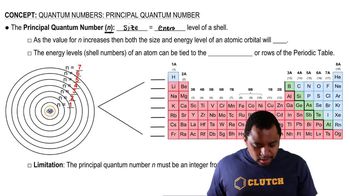
Identify the principal quantum number (n), which indicates the energy level and size of the orbital. It must be a positive integer.
Check the azimuthal quantum number (l), which defines the shape of the orbital. It must be an integer ranging from 0 to n-1.
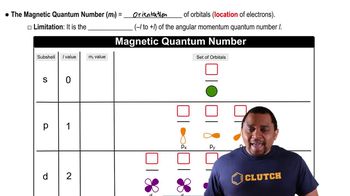
Examine the magnetic quantum number (ml), which describes the orientation of the orbital in space. It must be an integer ranging from -l to +l.
Review each set of quantum numbers to ensure that the values of l and ml are within the allowed ranges based on the value of n.
Identify any set where l is not less than n, or where ml is not within the range of -l to +l, as these would be quantum numbers that cannot occur together.

Risposta video verificata per un problema simile:

Questa soluzione video è stata consigliata dai nostri tutor come utile per risolvere questo problema.
Durata del video:
3m

Concetti chiave

Ecco i concetti essenziali che devi comprendere per rispondere correttamente alla domanda.

Quantum Numbers

Quantum numbers are a set of four numbers that describe the unique quantum state of an electron in an atom. They include the principal quantum number (n), azimuthal quantum number (l), magnetic quantum number (ml), and spin quantum number (ms). Each number has specific rules governing its possible values, which are essential for determining the electron's energy level, shape, orientation, and spin.
Video consigliato:
Percorso guidato
02:55
Principal Quantum Number

Principal Quantum Number (n)

The principal quantum number (n) indicates the main energy level or shell of an electron in an atom. It can take positive integer values (1, 2, 3, ...), with higher values corresponding to higher energy levels and greater distances from the nucleus. The value of n determines the overall size and energy of the orbital.
Video consigliato:
Percorso guidato
02:55
Principal Quantum Number

Azimuthal Quantum Number (l)

The azimuthal quantum number (l) defines the shape of the orbital and can take integer values from 0 to (n-1). Each value of l corresponds to a specific type of orbital: 0 for s, 1 for p, 2 for d, and 3 for f orbitals. The value of l must always be less than n, which is crucial for determining valid combinations of quantum numbers.
Video consigliato:
Percorso guidato
03:06
Magnetic Quantum Number