Choose the element with the higher first ionization energy from each pair. d. S or Sn

Ch.9 - Periodic Properties of the Elements

Tro6th EditionChemistry: A Molecular ApproachISBN: 9780137832217Non è quello che usi tu?Cambia libro di testo
Capitolo 9, Problema 78
Choose the element with the higher first ionization energy from each pair. a. Ge or Br b. P or In c. S or Te d. As or Br
Guida verificata passo dopo passo1
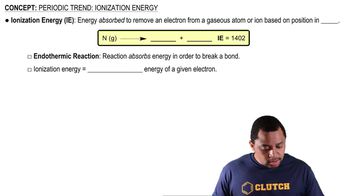
Understand that the first ionization energy is the energy required to remove the outermost electron from a neutral atom in the gaseous state.
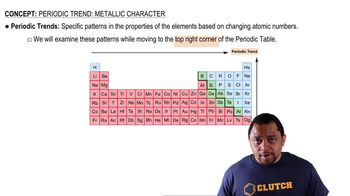
Recall that ionization energy generally increases across a period (from left to right) on the periodic table due to increasing nuclear charge and decreases down a group (from top to bottom) due to increasing atomic size and electron shielding.
For each pair, identify their positions on the periodic table: a. Ge (Germanium) and Br (Bromine) are in the same period, with Br to the right of Ge. b. P (Phosphorus) is above In (Indium) in the same group. c. S (Sulfur) is above Te (Tellurium) in the same group. d. As (Arsenic) and Br (Bromine) are in the same period, with Br to the right of As.
Apply the periodic trend: a. Since Br is to the right of Ge in the same period, Br has a higher first ionization energy. b. Since P is above In in the same group, P has a higher first ionization energy. c. Since S is above Te in the same group, S has a higher first ionization energy. d. Since Br is to the right of As in the same period, Br has a higher first ionization energy.
Conclude that the elements with higher first ionization energies are: a. Br, b. P, c. S, d. Br.

Risposta video verificata per un problema simile:
Questa soluzione video è stata consigliata dai nostri tutor come utile per risolvere questo problema.
Durata del video:
6mConcetti chiave
Ecco i concetti essenziali che devi comprendere per rispondere correttamente alla domanda.
Ionization Energy
Ionization energy is the energy required to remove an electron from a gaseous atom or ion. It is a key indicator of how strongly an atom holds onto its electrons. Generally, ionization energy increases across a period in the periodic table due to increasing nuclear charge and decreases down a group due to increased distance from the nucleus and electron shielding.
Video consigliato:
Percorso guidato
Ionization Energy
Periodic Trends
Periodic trends refer to the predictable patterns observed in the properties of elements as you move across or down the periodic table. For ionization energy, elements on the right side of the table (like halogens) typically have higher ionization energies than those on the left (like alkali metals). Understanding these trends helps in predicting which element in a pair will have a higher ionization energy.
Video consigliato:
Percorso guidato
Periodic Trends
Comparison of Elements
When comparing elements for their ionization energies, it is essential to consider their positions in the periodic table. Elements in the same group have similar properties, but the one higher up usually has a higher ionization energy due to less electron shielding. In contrast, elements in the same period will show increasing ionization energy from left to right, allowing for effective comparisons between pairs.
Video consigliato:
Percorso guidato
Elemental Forms of Elements
Pratica correlata
Domanda del libro di testo
For each element, predict where the "jump" occurs for successive ionization energies. (For example, does the jump occur between the first and second ionization energies, the second and third, the third and fourth, and so on?) a. B b. Na C. P d. S
Domanda del libro di testo
Choose the element with the higher first ionization energy from each pair. c. As or F
Domanda del libro di testo
Arrange these elements in order of increasing first ionization energy: Si, F, In, N.
1501
views
2
rank
Domanda del libro di testo
Choose the element with the higher first ionization energy from each pair. b. Li or K
Domanda del libro di testo
Consider this set of ionization energies.
IE1 = l000 kJ/mol
IE2 = 2250 kJ/mol
IE3 = 3360 kJ/mol
IE4 = 4560 kJ/mol
IE5 = 7010 kJ/mol
IE6 = 8500 kJ/mol
IE = 27,I00 kJ/mol
To which third-period element do these ionization values belong?