Ch.9 - Periodic Properties of the Elements
Tro - Chemistry: A Molecular Approach 6th Edition
Tro6th EditionChemistry: A Molecular ApproachISBN: 9780137832217Non è quello che usi tu?Cambia libro di testo
Capitolo 9, Problema 51b

Determine the number of valence electrons in an atom of each element. b. Sr

Guida verificata passo dopo passo
1
Step 1: Identify the element on the periodic table. Strontium (Sr) is in the second group (IIA) of the periodic table.
Step 2: The group number of an element in the periodic table can be used to determine the number of valence electrons. For elements in group IIA, they have 2 valence electrons.
Step 3: Therefore, an atom of Strontium (Sr) has 2 valence electrons.

Risposta video verificata per un problema simile:

Questa soluzione video è stata consigliata dai nostri tutor come utile per risolvere questo problema.
Durata del video:
37s

Concetti chiave

Ecco i concetti essenziali che devi comprendere per rispondere correttamente alla domanda.

Valence Electrons

Valence electrons are the electrons located in the outermost shell of an atom. They play a crucial role in chemical bonding and reactions, as they are the electrons that can be gained, lost, or shared when atoms interact. The number of valence electrons can often be determined by an element's position in the periodic table.
Video consigliato:
Percorso guidato
02:12
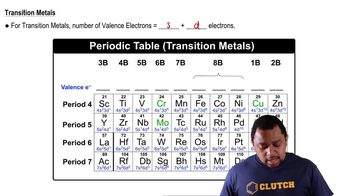
Transition Metals Valence Electrons

Periodic Table

The periodic table organizes elements based on their atomic number and electron configuration. Elements in the same group (column) typically have the same number of valence electrons, which influences their chemical properties. For example, alkaline earth metals like strontium (Sr) are found in Group 2 and have two valence electrons.
Video consigliato:
Percorso guidato
02:40
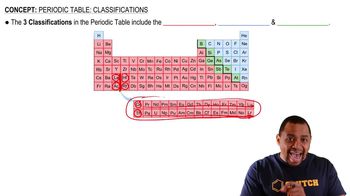
Periodic Table Classifications

Strontium (Sr)

Strontium is a chemical element with the symbol Sr and atomic number 38. It is classified as an alkaline earth metal, which means it has two valence electrons in its outermost shell. This characteristic contributes to its reactivity and the types of compounds it can form.
Video consigliato:
Percorso guidato
01:57
Base Properties