Ch.9 - Periodic Properties of the Elements
Tro - Chemistry: A Molecular Approach 6th Edition
Tro6th EditionChemistry: A Molecular ApproachISBN: 9780137832217Non è quello che usi tu?Cambia libro di testo
Capitolo 9, Problema 48

Use the periodic table to determine each quantity.
b. the number of 3d electrons in Cr

Guida verificata passo dopo passo
1
Identify the electron configuration of chromium (Cr) using the periodic table.
Recall that chromium is an exception to the typical electron configuration rules.
Write the electron configuration for Cr: \([\text{Ar}] 3d^5 4s^1\).
Determine the number of electrons in the 3d subshell from the electron configuration.
Conclude that the number of 3d electrons in Cr is the number of electrons in the 3d subshell.

Risposta video verificata per un problema simile:

Questa soluzione video è stata consigliata dai nostri tutor come utile per risolvere questo problema.
Durata del video:
3m

Concetti chiave

Ecco i concetti essenziali che devi comprendere per rispondere correttamente alla domanda.

Electron Configuration

Electron configuration describes the distribution of electrons in an atom's orbitals. For transition metals like chromium (Cr), the electron configuration is crucial for understanding how many electrons occupy specific subshells, such as the 3d subshell. Chromium has an atomic number of 24, and its electron configuration is [Ar] 3d5 4s1, indicating it has five electrons in the 3d subshell.
Video consigliato:
Percorso guidato
01:33
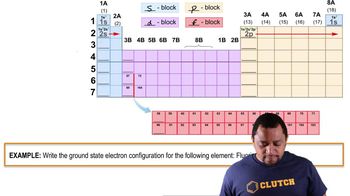
Electron Configuration Example

Transition Metals

Transition metals are elements found in the d-block of the periodic table, characterized by their ability to form variable oxidation states and colored compounds. They typically have partially filled d orbitals, which play a significant role in their chemical properties and bonding behavior. Understanding the unique characteristics of transition metals is essential for determining electron counts in specific subshells.
Video consigliato:
Percorso guidato
03:12
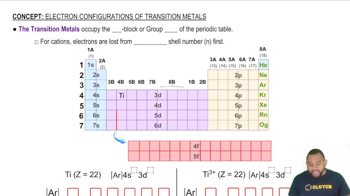
Transition Metals

Periodic Table Trends

The periodic table organizes elements based on their atomic number and electron configurations, revealing trends in properties such as electronegativity, ionization energy, and atomic size. These trends help predict the behavior of elements, including how many electrons occupy certain orbitals. For chromium, recognizing its position in the periodic table aids in understanding its electron configuration and the number of 3d electrons.
Video consigliato:
Percorso guidato
00:38
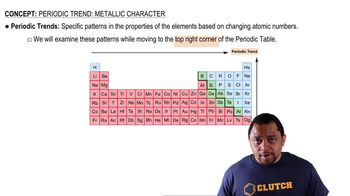
Periodic Trends