Ch.9 - Periodic Properties of the Elements
Tro - Chemistry: A Molecular Approach 6th Edition
Tro6th EditionChemistry: A Molecular ApproachISBN: 9780137832217Non è quello che usi tu?Cambia libro di testo
Capitolo 9, Problema 39

Write the full electron configuration for each element. . P b. F c. Ca d. Ar

Guida verificata passo dopo passo
1
Identify the atomic number of each element from the periodic table. The atomic number tells you the number of protons and, in a neutral atom, the number of electrons.
Use the periodic table to determine the order in which the electron orbitals are filled. Remember the order: 1s, 2s, 2p, 3s, 3p, 4s, 3d, 4p, 5s, 4d, 5p, 6s, 4f, 5d, 6p, 7s, 5f, 6d, 7p.
Fill the orbitals according to the Aufbau principle, which states that electrons occupy the lowest energy orbital available. Also, apply Hund's rule which states that electrons will fill an unoccupied orbital before they pair up in an occupied one.
Use the Pauli Exclusion Principle to ensure that no two electrons in an atom have the same set of four quantum numbers. This means each orbital can hold a maximum of two electrons with opposite spins.
Write the electron configuration for each element by listing the orbitals in order of filling and indicating the number of electrons in each orbital using superscripts. For example, helium (He) with two electrons would be written as 1s^2.

Risposta video verificata per un problema simile:

Questa soluzione video è stata consigliata dai nostri tutor come utile per risolvere questo problema.
Durata del video:
4m

Concetti chiave

Ecco i concetti essenziali che devi comprendere per rispondere correttamente alla domanda.

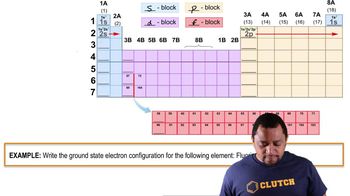
Electron Configuration

Electron configuration describes the distribution of electrons in an atom's orbitals. It follows the Aufbau principle, which states that electrons fill the lowest energy orbitals first, and is represented using a notation that includes the principal quantum number and the type of orbital (s, p, d, f). For example, the electron configuration of oxygen is 1s² 2s² 2p⁴.
Video consigliato:
Percorso guidato
01:33
Electron Configuration Example

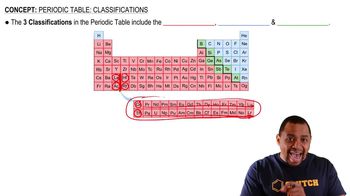
Periodic Table and Atomic Structure

The periodic table organizes elements based on their atomic number and electron configurations, which influence their chemical properties. Elements in the same group have similar valence electron configurations, affecting their reactivity and bonding behavior. Understanding an element's position in the periodic table helps predict its electron configuration.
Video consigliato:
Percorso guidato
02:40
Periodic Table Classifications

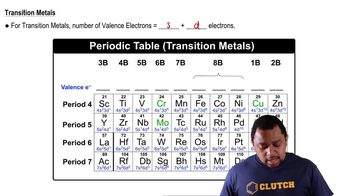
Valence Electrons

Valence electrons are the outermost electrons of an atom and play a crucial role in chemical bonding and reactivity. The number of valence electrons determines how an element interacts with others, forming bonds to achieve a stable electron configuration, often resembling that of noble gases. For instance, elements in group 1 have one valence electron, while those in group 17 have seven.
Video consigliato:
Percorso guidato
02:12
Transition Metals Valence Electrons