Skip to main content
Genetics
Il mio corso
Impara
Preparazione agli esami
AI Tutor
Guide di studio
Soluzioni per libri di testo
Flashcard
Esplora
Prova l'app
Il mio corso
Impara
Preparazione agli esami
AI Tutor
Guide di studio
Soluzioni per libri di testo
Flashcard
Esplora
Prova l'app
Indietro
Genomics and Human Medicine definitions
Puoi toccare per girare la carta.
Human Genome Project
Puoi toccare per girare la carta.
👆
Human Genome Project
A global scientific effort that provided the first complete sequence of human DNA, revealing unexpected proportions of coding and non-coding regions.
Avanzamenti del tracciato
I pulsanti di controllo sono stati cambiati in modalità "navigazione".
1/15
Flashcard correlate
Pratica correlata
Video consigliati
Genomics and Human Medicine quiz #1
Genomics and Human Medicine
10 Termini
Genomics and Human Medicine
15. Genomes and Genomics
7 Problemi
Argomento
Kylia
Functional Genomics
15. Genomes and Genomics
8 Problemi
Argomento
Kylia
15. Genomes and Genomics - Part 1 of 2
5 Argomenti
10 Problemi
Capitolo
Kylia
15. Genomes and Genomics - Part 2 of 2
4 Argomenti
10 Problemi
Capitolo
Kylia
VideoThumbView.guidedCourse
09:12
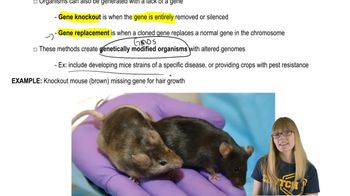
Transgenic Organisms and Gene Therapy
898
views
4
rank
1
comments
VideoThumbView.guidedCourse
06:51
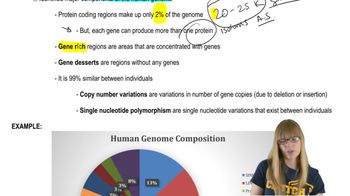
Human Genome Composition
998
views
4
rank
Termini in questo insieme (15)
Nascondere definizioni
Human Genome Project
A global scientific effort that provided the first complete sequence of human DNA, revealing unexpected proportions of coding and non-coding regions.
Protein-coding gene
A DNA segment responsible for producing proteins, representing only a small fraction of the entire human genome.
Alternative splicing
A process allowing a single gene to generate multiple protein variants by rearranging its exons during RNA processing.
Copy number variation
A genetic difference where sections of DNA are duplicated or deleted, contributing to diversity even among identical twins.
Single nucleotide polymorphism
A variation at a single DNA base position among individuals, serving as a major source of genetic diversity.
Transposon
A mobile DNA sequence capable of moving within the genome, sometimes called a 'jumping gene,' influencing genome structure.
Intron
A non-coding DNA segment within a gene, situated between exons, often removed during RNA processing.
Pseudogene
A DNA sequence resembling a gene but rendered nonfunctional due to mutations or insertions.
Gene desert
A large genomic region lacking protein-coding genes, often associated with inactive chromatin.
Transgenic organism
An organism engineered to contain DNA from another species, commonly used to study gene function or model diseases.
Gene addition
A genetic engineering method where a new gene is inserted into an organism's genome, not necessarily at a specific site.
Gene knock-in
A precise genetic modification where a gene is inserted at a targeted location, often with a specific promoter for expression.
Gene knockout
A genetic technique where a gene is completely inactivated or removed to study its function.
Gene therapy
A medical approach aiming to treat diseases by delivering functional genes to replace or supplement defective ones.
Liposome
A lipid-based vesicle used to deliver therapeutic DNA into cells without using viruses, especially in gene therapy.
 IndietroIndietro
 09:12
09:12