Skip to main content
Genetics
Il mio corso
Impara
Preparazione agli esami
AI Tutor
Guide di studio
Soluzioni per libri di testo
Flashcard
Esplora
Prova l'app
Il mio corso
Impara
Preparazione agli esami
AI Tutor
Guide di studio
Soluzioni per libri di testo
Flashcard
Esplora
Prova l'app
Indietro
Mapping Genes quiz
Puoi toccare per girare la carta.
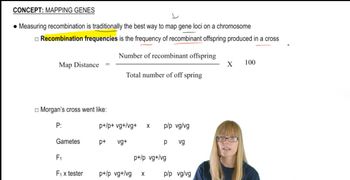
What formula is used to calculate recombination frequency in gene mapping?
Puoi toccare per girare la carta.
👆
What formula is used to calculate recombination frequency in gene mapping?
Recombination frequency is calculated as (number of recombinant offspring / total number of offspring) x 100.
Avanzamenti del tracciato
I pulsanti di controllo sono stati cambiati in modalità "navigazione".
1/15
Flashcard correlate
Pratica correlata
Video consigliati
Mapping Genes definitions
Mapping Genes
15 Termini
Mapping Genes
4. Genetic Mapping and Linkage
7 Problemi
Argomento
Kylia
Trihybrid Cross
4. Genetic Mapping and Linkage
7 Problemi
Argomento
Kylia
4. Genetic Mapping and Linkage - Part 1 of 2
4 Argomenti
11 Problemi
Capitolo
Kylia
4. Genetic Mapping and Linkage - Part 2 of 2
5 Argomenti
10 Problemi
Capitolo
Kylia
VideoThumbView.guidedCourse
09:09
Mapping Genes
3515
views
31
rank
5
comments
VideoThumbView.guidedCourse
03:04
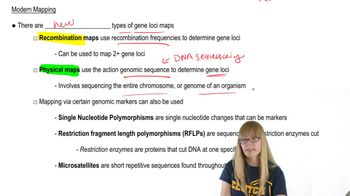
Modern Mapping
2315
views
15
rank
Termini in questo insieme (15)
Nascondere definizioni
What formula is used to calculate recombination frequency in gene mapping?
Recombination frequency is calculated as (number of recombinant offspring / total number of offspring) x 100.
What do recombinant offspring represent in a genetic cross?
Recombinant offspring are those whose phenotypes do not resemble either parent, indicating a mix of parental traits.
How is map distance related to recombination frequency?
Map distance is numerically equal to recombination frequency and is measured in map units (m.u.).
What does a recombination frequency of 10.7% indicate about gene distance?
It means the two genes are 10.7 map units apart on the chromosome.
What is the relationship between gene proximity and likelihood of crossover?
The closer two genes are on a chromosome, the less likely they are to undergo crossover and recombination.
How can you determine if two genes are linked based on recombination frequency?
Genes are considered linked if their recombination frequency is less than 50%.
What does a recombination frequency of 50% suggest about gene linkage?
A frequency of 50% suggests the genes are not linked and assort independently.
Why can recombination frequencies never exceed 50%?
Because independent assortment equally distributes alleles, making 50% the maximum possible recombination frequency.
What is the significance of parental types in Morgan's cross experiment?
Parental types are offspring that phenotypically resemble the original parents, used to distinguish recombinants.
What are physical maps in modern gene mapping?
Physical maps use genomic sequencing to identify gene locations based on nucleotide sequences.
What are SNPs and how are they used in gene mapping?
SNPs (single nucleotide polymorphisms) are single nucleotide changes used as markers to locate genes.
What are RFLPs and their role in gene mapping?
RFLPs (restriction fragment length polymorphisms) are DNA sequences cut by restriction enzymes, used to map gene locations.
What are microsatellites and why are they useful in gene mapping?
Microsatellites are short repetitive DNA sequences found throughout the genome, useful for identifying gene locations.
Why is understanding traditional gene mapping methods important?
Traditional methods provide foundational concepts for understanding how genes are located and mapped on chromosomes.
What is the main difference between traditional and modern gene mapping techniques?
Traditional mapping uses recombination frequencies, while modern techniques rely on genomic sequencing and molecular markers.
 IndietroIndietro
 09:09
09:09