Skip to main content
Genetics
Il mio corso
Impara
Preparazione agli esami
AI Tutor
Guide di studio
Soluzioni per libri di testo
Flashcard
Esplora
Prova l'app
Il mio corso
Impara
Preparazione agli esami
AI Tutor
Guide di studio
Soluzioni per libri di testo
Flashcard
Esplora
Prova l'app
Indietro
Translation definitions
Puoi toccare per girare la carta.
Translation
Puoi toccare per girare la carta.
👆
Translation
Process converting mRNA into a protein by sequential addition of amino acids, involving ribosomes and tRNAs.
Avanzamenti del tracciato
I pulsanti di controllo sono stati cambiati in modalità "navigazione".
1/15
Flashcard correlate
Pratica correlata
Video consigliati
Translation quiz #1
Translation
20 Termini
Translation
11. Translation
7 Problemi
Argomento
Kylia
Proteins
11. Translation
7 Problemi
Argomento
Kylia
11. Translation
5 Argomenti
13 Problemi
Capitolo
Kylia
VideoThumbView.guidedCourse
01:55
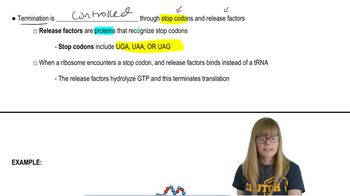
Translation Termination
1712
views
14
rank
2
comments
VideoThumbView.guidedCourse
07:58
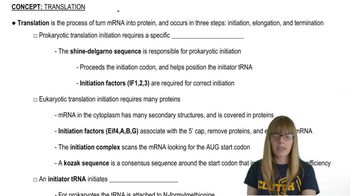
Translation initiation
2453
views
35
rank
4
comments
VideoThumbView.guidedCourse
03:13
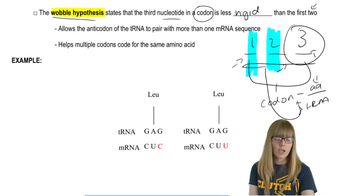
Translation:Wobble Hypothesis
1945
views
13
rank
1
comments
Termini in questo insieme (15)
Nascondere definizioni
Translation
Process converting mRNA into a protein by sequential addition of amino acids, involving ribosomes and tRNAs.
Initiation
First stage where ribosomal subunits, mRNA, and initiator tRNA assemble to begin protein synthesis.
Elongation
Middle stage where amino acids are sequentially added to the growing polypeptide chain by ribosomal movement.
Termination
Final stage where a stop codon is recognized, leading to release of the completed polypeptide from the ribosome.
Shine-Dalgarno Sequence
Prokaryotic mRNA region upstream of the start codon that aligns ribosomes for accurate translation initiation.
Kozak Sequence
Eukaryotic consensus sequence surrounding the start codon, enhancing translation efficiency and accuracy.
Initiation Factors
Proteins (IFs in prokaryotes, EIFs in eukaryotes) that help assemble the translation initiation complex and prepare mRNA.
Elongation Factors
Proteins (e.g., EF2, EFG) that use GTP to facilitate tRNA movement and peptide bond formation during elongation.
Release Factors
Proteins that recognize stop codons, bind to the ribosome, and trigger release of the newly made polypeptide.
Ribosome
Molecular machine with A, P, and E sites that coordinates decoding of mRNA and synthesis of polypeptides.
tRNA
Adaptor molecule carrying specific amino acids and matching mRNA codons via its anticodon during translation.
Start Codon
AUG sequence on mRNA signaling where translation begins and specifying methionine as the first amino acid.
Stop Codon
mRNA sequence (e.g., UAA, UAG, UGA) that signals the end of translation and prompts polypeptide release.
Wobble Hypothesis
Concept explaining flexible base pairing at the third codon position, allowing one tRNA to recognize multiple codons.
Polypeptide Chain
Linear sequence of amino acids synthesized during translation, forming the primary structure of a protein.
 IndietroIndietro
 01:55
01:55