A single gene controls the synthesis of a single enzyme. Modifications include that enzymes are one protein category, some proteins have multiple polypeptides, some genes code for functional RNAs, and one gene can code for multiple polypeptides.
Genetic code
The set of rules by which information encoded in mRNA codons is translated into amino acids in proteins. It uses triplet codons, start codon AUG, and stop codons UAA, UAG, UGA.
Degeneracy of the genetic code
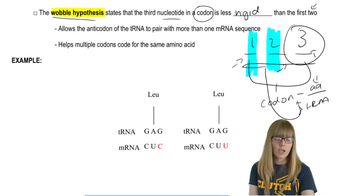
Multiple codons can specify the same amino acid, e.g., GGU, GGC, GGA, and GGG all code for glycine. These are called synonymous codons.
Exceptions to the genetic code
Selenocysteine (Sec) and pyrrolysine (Pyl) are rare amino acids coded by UGA and UAG codons, respectively, requiring special tRNAs and mRNA sequences.
Reading frame
The series of codons in mRNA starting with the start codon. A frameshift mutation changes the reading frame, altering the entire downstream amino acid sequence.
Directionality of polypeptide synthesis
Polypeptides are synthesized from the amino (N) terminus to the carboxyl (C) terminus, while mRNA is read 5-prime to 3-prime.
Levels of protein structure
Primary: amino acid sequence; Secondary: alpha helices and beta sheets; Tertiary: 3D folding; Quaternary: multiple polypeptides forming a complex.
tRNAs have a cloverleaf secondary structure with an anticodon loop that pairs with mRNA codons and a 3-prime CCA end where the amino acid attaches.
Charging of tRNAs
Aminoacyl-tRNA synthetases catalyze attachment of amino acids to tRNAs in a two-step reaction using ATP, producing charged tRNAs for translation.
Shine-Dalgarno sequence
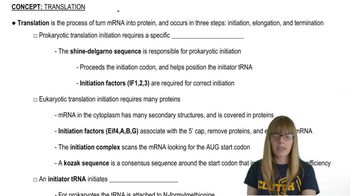
A ribosomal binding site in bacterial mRNA complementary to 16S rRNA that helps position the mRNA for translation initiation.
Kozak sequence
A consensus sequence around the start codon in eukaryotic mRNAs that facilitates recognition of the correct AUG for translation initiation.
Decoding function of the ribosome
The 16S rRNA monitors correct codon-anticodon pairing at the A site and prevents elongation if an incorrect tRNA is bound.
Peptidyl transferase activity
Catalyzed by 23S rRNA in the large ribosomal subunit, it forms peptide bonds between amino acids during elongation.
Triplet-binding assay
An experimental method to identify which RNA triplets bind specific tRNAs carrying amino acids, helping decipher the genetic code.
RNA copolymers in genetic code research
Synthetic RNAs with repeating sequences were used in cell-free systems to identify codons corresponding to specific amino acids.
Differences in translation among domains
Bacteria use fMet-tRNA and Shine-Dalgarno sequences; archaea and eukaryotes use Met-tRNA and different initiation factors; eukaryotes require 5-prime cap recognition.
 Indietro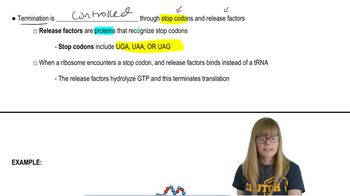
 01:55
01:55