The glycocalyx is a carbohydrate-rich coating on the plasma membrane of animal cells. It aids in cell recognition, adhesion, protection, and communication.
What is the nucleolar organizer region (NOR)?
The NOR is a chromosomal region containing genes coding for ribosomal RNA (rRNA), essential for ribosome production and protein synthesis.
What role does the cytoskeleton play in cell division?
The cytoskeleton organizes and moves chromosomes during cell division, forming structures like spindle fibers and centrioles.
Define homologous chromosomes, sister chromatids, and centromere.
Homologous chromosomes are chromosome pairs with the same genes. Sister chromatids are identical copies joined at the centromere, the chromosome's constricted region.
What are the centromere region designations?
Centromere regions include the p arm (short arm) and q arm (long arm), which determine chromosome shape.
Differentiate metacentric, acrocentric, and telocentric chromosomes.
Metacentric: centromere in middle; acrocentric: centromere near one end; telocentric: centromere at the end.
What is a karyotype?
A karyotype is an organized profile of an organism's chromosomes, showing homologous pairs arranged by size and shape.
What are the main phases of the cell cycle?
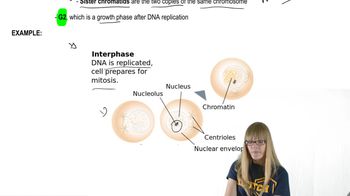
The cell cycle includes G1 (growth), S (DNA synthesis), G2 (preparation for mitosis), and M (mitosis).
Describe the key events of mitotic prophase.
Centrioles divide and move to poles, nuclear envelope breaks down, and chromosomes condense and become visible.
What holds sister chromatids together?
Sister chromatids are held by the protein complex cohesin at the centromere.
What happens during prometaphase?
Chromosomes move to the metaphase plate; spindle fibers form and attach to kinetochores on centromeres.
What is the role of the kinetochore?
The kinetochore is a protein structure on the centromere where spindle fibers attach to move chromosomes.
 Indietro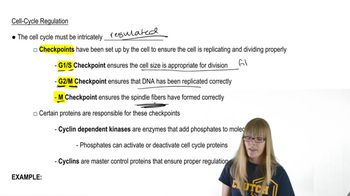
 05:02
05:02