
Ch. 6 - Chromosome Mutations: Variation in Number and Arrangement
Klug - Essentials of Genetics 10th Edition
Klug10th EditionEssentials of GeneticsISBN: 9780135588789Non è quello che usi tu?Cambia libro di testo
Capitolo 6, Problema 27

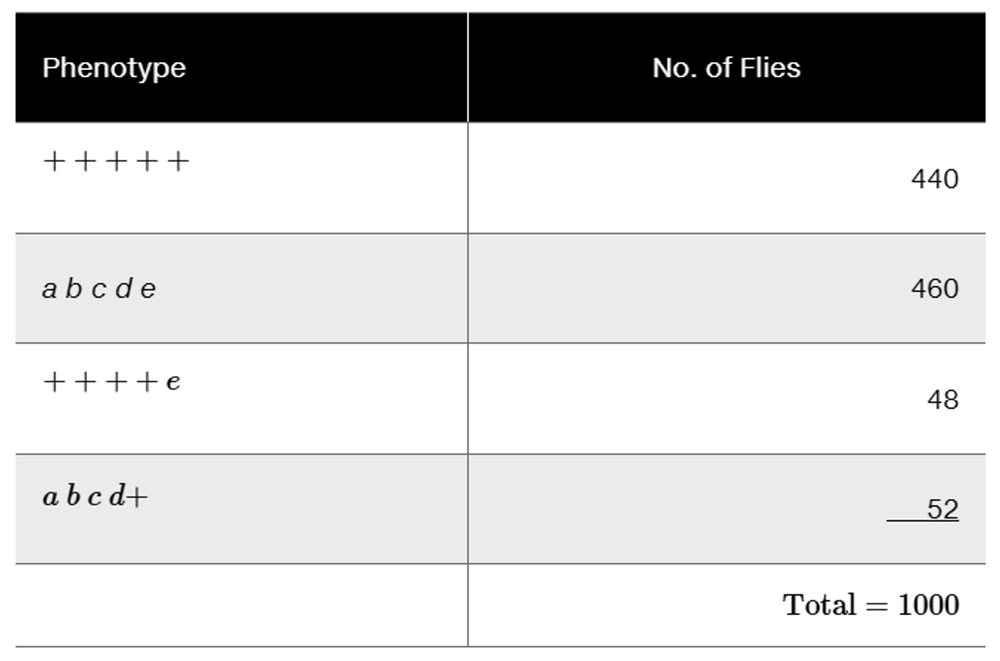
In a cross in Drosophila, a female heterozygous for the autosomally linked genes a, b, c, d, and e (abcde/ +++++) was testcrossed with a male homozygous for all recessive alleles. Even though the distance between each of the loci was at least 3 map units, only four phenotypes were recovered, yielding the following data:
Table showing four Drosophila phenotypes with corresponding fly counts totaling 1000: 440, 460, 48, and 52 flies.
Why are many expected crossover phenotypes missing? Can any of these loci be mapped from the data given here? If so, determine map distances.

Guida verificata passo dopo passo
1
Step 1: Identify the parental and recombinant phenotypes from the data. The two most frequent phenotypes (+++++ with 440 flies and abcde with 460 flies) represent the parental types, while the less frequent phenotypes (++ ++e with 48 flies and abcd+ with 52 flies) represent single crossover recombinants. The absence of other recombinant phenotypes suggests double or multiple crossovers are not observed.
Step 2: Understand why many expected crossover phenotypes are missing. Since the genes are autosomally linked and the distance between each locus is at least 3 map units, double or multiple crossovers are expected but not observed here. This is likely due to crossover interference, where one crossover event reduces the probability of another nearby crossover, leading to fewer double crossover phenotypes than expected.
Step 3: Determine which loci can be mapped from the data. Because only single crossover classes involving the last gene 'e' are observed, it suggests that only the distance between gene 'd' and gene 'e' can be reliably estimated from this data. Other distances cannot be mapped accurately without additional recombinant classes.
Step 4: Calculate the recombination frequency between loci 'd' and 'e'. Use the formula for recombination frequency (RF): \[\text{RF} = \frac{\text{Number of recombinant offspring}}{\text{Total number of offspring}} \times 100\] Here, the recombinant offspring are those with phenotypes ++++e and abcd+, totaling 48 + 52 flies.
Step 5: Convert the recombination frequency to map units (centiMorgans, cM). Since 1% recombination frequency corresponds to 1 map unit, the distance between loci 'd' and 'e' is numerically equal to the recombination frequency calculated in Step 4.

Risposta video verificata per un problema simile:

Questa soluzione video è stata consigliata dai nostri tutor come utile per risolvere questo problema.
Durata del video:
4m

Concetti chiave

Ecco i concetti essenziali che devi comprendere per rispondere correttamente alla domanda.

Genetic Linkage and Recombination

Genetic linkage occurs when genes are located close together on the same chromosome and tend to be inherited together. Recombination during meiosis can separate linked genes, producing new allele combinations. The frequency of recombination between two loci is proportional to their physical distance, measured in map units or centimorgans.
Video consigliato:
Percorso guidato
07:33
Chi Square and Linkage

Testcross and Phenotypic Ratios

A testcross involves crossing an individual heterozygous for certain genes with a homozygous recessive individual to reveal the genotype of the heterozygote. The phenotypic ratios of offspring reflect the parental and recombinant types, allowing inference of gene order and recombination frequencies.
Video consigliato:
Percorso guidato
10:48
Mutations and Phenotypes

Interference and Double Crossovers

Interference is the phenomenon where one crossover event reduces the likelihood of another nearby crossover, leading to fewer double crossover phenotypes than expected. This can cause missing or underrepresented recombinant classes in genetic data, complicating mapping of loci.
Video consigliato:
Percorso guidato
06:59
RNA Interference