Ch. 10 - DNA Structure and Analysis
Klug - Concepts of Genetics 12th Edition
Klug12th EditionConcepts of GeneticsISBN: 9780135564776Non è quello che usi tu?Cambia libro di testo
Capitolo 10, Problema 27

Considering the information on B- and Z-DNA and right- and left-handed helices, carefully analyze structures (a) and (b) below and draw conclusions about their helical nature. Which is right-handed and which is left-handed?

Guida verificata passo dopo passo
1
Examine the structural features of B-DNA and Z-DNA. B-DNA is a right-handed helix, characterized by a smooth backbone and consistent major and minor grooves. Z-DNA is a left-handed helix, with a zigzag backbone and alternating purine-pyrimidine sequences.
Identify the handedness of a helix by observing the direction of the twist. A right-handed helix twists clockwise when viewed from the top, while a left-handed helix twists counterclockwise.
Analyze structure (a) and determine the direction of its twist. Look for characteristics such as the smooth or zigzag backbone and the orientation of the grooves to infer whether it is B-DNA or Z-DNA.
Analyze structure (b) using the same criteria. Observe the twist direction and structural features to determine whether it is right-handed or left-handed.
Compare the findings for structures (a) and (b) to conclude which one is right-handed and which one is left-handed, based on the observed characteristics and the definitions of B-DNA and Z-DNA.

Risposta video verificata per un problema simile:

Questa soluzione video è stata consigliata dai nostri tutor come utile per risolvere questo problema.
Durata del video:
2m

Concetti chiave

Ecco i concetti essenziali che devi comprendere per rispondere correttamente alla domanda.

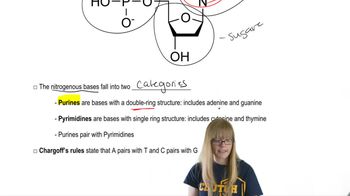
B-DNA and Z-DNA Structures

B-DNA is the most common form of DNA in cells, characterized by a right-handed helix with about 10.5 base pairs per turn. In contrast, Z-DNA is a left-handed helix that forms under certain conditions, such as high salt concentrations or specific sequences. Understanding these structural differences is crucial for analyzing the helical nature of DNA.
Video consigliato:

Right-Handed vs. Left-Handed Helices

The terms 'right-handed' and 'left-handed' refer to the direction in which the helix twists. Right-handed helices, like B-DNA, twist clockwise, while left-handed helices, like Z-DNA, twist counterclockwise. This distinction affects the physical properties and biological functions of the DNA.
Video consigliato:
Percorso guidato
03:38
Maternal Effect

Helical Parameters and Analysis

Helical parameters, such as pitch, rise per base pair, and base pair orientation, are essential for determining the handedness of a DNA structure. By analyzing these parameters in the provided structures, one can conclude whether they exhibit right-handed or left-handed helical characteristics, which is vital for understanding their biological roles.
Video consigliato:
Percorso guidato
02:48
Chi Square Analysis
Pratica correlata
Domanda del libro di testo

What did the Watson–Crick model suggest about the replication of DNA?

1226
views
Domanda del libro di testo

One of the most common spontaneous lesions that occurs in DNA under physiological conditions is the hydrolysis of the amino group of cytosine, converting the cytosine to uracil. What would be the effect on DNA structure of a uracil group replacing cytosine?

674
views
Domanda del libro di testo

A genetics student was asked to draw the chemical structure of an adenine- and thymine-containing dinucleotide derived from DNA. The answer is shown here:

The student made more than six major errors. One of them is circled, numbered 1, and explained. Find five others. Circle them, number them 2 through 6, and briefly explain each in the manner of the example given.

801
views
Domanda del libro di testo

Because of its rapid turnaround time, fluorescent in situ hybridization (FISH) is commonly used in hospitals and laboratories as an aneuploid screen of cells retrieved from amniocentesis and chorionic villus sampling (CVS). Chromosomes 13, 18, 21, X, and Y are typically screened for aneuploidy in this way. Explain how FISH might be accomplished using amniotic or CVS samples and why the above chromosomes have been chosen for screening.

543
views
Domanda del libro di testo

What is the chemical basis of molecular hybridization?

1010
views
Domanda del libro di testo

In some organisms, cytosine is methylated at carbon 5 of the pyrimidine ring after it is incorporated into DNA. If a 5-methyl cytosine molecule is then hydrolyzed, what base will be generated?

643
views