Ch. 12 - DNA Organization in Chromosomes
Klug - Concepts of Genetics 12th Edition
Klug12th EditionConcepts of GeneticsISBN: 9780135564776Non è quello che usi tu?Cambia libro di testo
Capitolo 12, Problema 3

Contrast the size of the single chromosome in bacteriophage and T2 with that of E. coli. How does this relate to the relative size and complexity of phages and bacteria?

Guida verificata passo dopo passo
1
Step 1: Understand the basic difference in genome size between bacteriophages (like T2) and bacteria (like E. coli). Bacteriophages typically have a single chromosome that is much smaller in size compared to the bacterial chromosome.
Step 2: Identify the approximate size of the bacteriophage T2 genome, which is usually measured in thousands of base pairs (kbp), and compare it to the E. coli genome size, which is measured in millions of base pairs (Mbp).
Step 3: Recognize that the smaller genome size of bacteriophages reflects fewer genes and simpler genetic information, which corresponds to their simpler structure and life cycle compared to bacteria.
Step 4: Understand that the larger genome of E. coli encodes for more complex cellular machinery and metabolic pathways, supporting its status as a free-living organism with more complex functions.
Step 5: Conclude that the difference in chromosome size directly relates to the relative complexity of the organisms: bacteriophages are simpler viruses with smaller genomes, while bacteria like E. coli are more complex, with larger genomes encoding more functions.

Risposta video verificata per un problema simile:

Questa soluzione video è stata consigliata dai nostri tutor come utile per risolvere questo problema.
Durata del video:
1m

Concetti chiave

Ecco i concetti essenziali che devi comprendere per rispondere correttamente alla domanda.

Chromosome Size in Bacteriophages and Bacteria

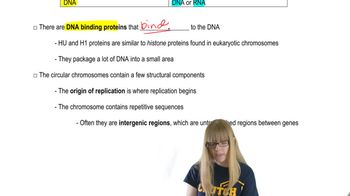
Bacteriophages like T2 have much smaller chromosomes, typically consisting of a few tens of thousands of base pairs, compared to E. coli, whose chromosome contains millions of base pairs. This size difference reflects the simpler genetic content of phages versus bacteria.
Video consigliato:
Percorso guidato
02:39
Bacteria and Viral Chromosome Structure

Genomic Complexity and Organismal Complexity

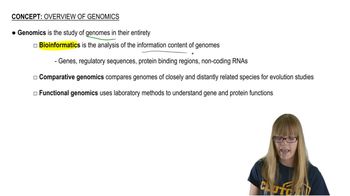
The size of an organism's genome often correlates with its biological complexity. Bacteriophages have compact genomes encoding only essential proteins for infection and replication, while E. coli's larger genome encodes a wide array of functions needed for independent life.
Video consigliato:
Percorso guidato
02:48
Genomics Overview

Functional Implications of Genome Size

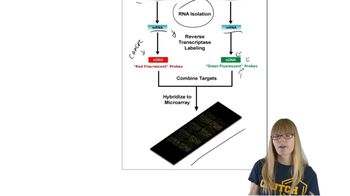
Smaller genomes in phages mean fewer genes and simpler regulatory mechanisms, relying on host machinery for replication. In contrast, E. coli's larger genome supports diverse metabolic pathways and environmental adaptability, highlighting the relationship between genome size and functional capacity.
Video consigliato:
Percorso guidato
08:26
Functional Genomics
Pratica correlata
Domanda del libro di testo

Write a short essay that contrasts the major differences between the organization of DNA in viruses and bacteria versus eukaryotes.

452
views
Domanda del libro di testo

During what genetic process are lampbrush chromosomes present in vertebrates?

819
views
Domanda del libro di testo

Describe the structure of giant polytene chromosomes and how they arise.

662
views
Domanda del libro di testo

In the discussion, we focused on how DNA is organized at the chromosomal level. Along the way, we found many opportunities to consider the methods and reasoning by which much of this information was acquired. From the explanations given in the chapter, what answers would you propose to the following fundamental questions:

How do we know that satellite DNA consists of repetitive sequences and has been derived from regions of the centromere?

484
views
Domanda del libro di testo

In the discussion, we focused on how DNA is organized at the chromosomal level. Along the way, we found many opportunities to consider the methods and reasoning by which much of this information was acquired. From the explanations given in the chapter, what answers would you propose to the following fundamental questions:

How did we learn that eukaryotic chromatin exists in the form of repeating nucleosomes, each consisting of about 200 base pairs and an octamer of histones?

537
views
Domanda del libro di testo

What genetic process is occurring in a puff of a polytene chromosome? How do we know this experimentally?

807
views