Ch. 12 - DNA Organization in Chromosomes
Klug - Concepts of Genetics 12th Edition
Klug12th EditionConcepts of GeneticsISBN: 9780135564776Non è quello che usi tu?Cambia libro di testo
Capitolo 12, Problema 12

Mammals contain a diploid genome consisting of at least 10⁹ bp. If this amount of DNA is present as chromatin fibers, where each group of 200 bp of DNA is combined with 9 histones into a nucleosome and each group of 6 nucleosomes is combined into a solenoid, achieving a final packing ratio of 50, determine:
(a) the total number of nucleosomes in all fibers,
(b) the total number of histone molecules combined with DNA in the diploid genome, and
(c) the combined length of all fibers.

Guida verificata passo dopo passo
1
Identify the total amount of DNA base pairs (bp) given, which is at least 10⁹ bp for the diploid genome.
Calculate the total number of nucleosomes by dividing the total base pairs by the number of base pairs per nucleosome. Since each nucleosome contains 200 bp, use the formula: \(\text{Number of nucleosomes} = \frac{10^{9} \text{ bp}}{200 \text{ bp/nucleosome}}\).
Determine the total number of histone molecules by multiplying the number of nucleosomes by the number of histones per nucleosome. Given that each nucleosome has 9 histones, use: \(\text{Total histones} = \text{Number of nucleosomes} \times 9\).
Calculate the combined length of all chromatin fibers before packing. First, find the length of DNA per base pair (approximately 0.34 nm per bp), then multiply by the total number of base pairs: \(\text{DNA length} = 10^{9} \text{ bp} \times 0.34 \text{ nm/bp}\).
Adjust the length of the fibers to account for the packing ratio of 50, which means the chromatin fiber length is reduced by a factor of 50 compared to the extended DNA length. Use: \(\text{Fiber length} = \frac{\text{DNA length}}{50}\).

Risposta video verificata per un problema simile:

Questa soluzione video è stata consigliata dai nostri tutor come utile per risolvere questo problema.
Durata del video:
1m

Concetti chiave

Ecco i concetti essenziali che devi comprendere per rispondere correttamente alla domanda.

Nucleosome Structure and Composition

A nucleosome is the fundamental unit of chromatin, consisting of approximately 200 base pairs of DNA wrapped around a histone octamer made up of 8 histone proteins. The question states 9 histones per nucleosome, which may include an additional linker histone. Understanding nucleosome composition is essential to calculate the total number of nucleosomes and histones in the genome.
Video consigliato:
Percorso guidato
07:10
Chromosome Structure

Chromatin Fiber Organization and Solenoid Model

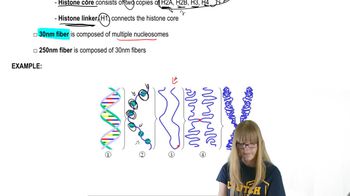
Chromatin fibers are formed by nucleosomes arranged into higher-order structures. Six nucleosomes fold into a solenoid fiber, which compacts DNA further. This hierarchical organization affects the overall length and packing ratio of DNA, crucial for determining the combined length of chromatin fibers.
Video consigliato:
Percorso guidato
07:55
Histone Protein Modifications

DNA Packing Ratio and Genome Size

The packing ratio describes how much the DNA length is reduced by chromatin folding. Given a diploid genome size of 10⁹ base pairs and a packing ratio of 50, this ratio helps convert the total DNA length into the length of compacted chromatin fibers, enabling calculations of fiber length and nucleosome numbers.
Video consigliato:
Percorso guidato
08:41
Sequencing Difficulties
Pratica correlata
Domanda del libro di testo

How many base pairs are in a molecule of phage T2 DNA 52-µm long?

838
views
Domanda del libro di testo

Describe the molecular composition and arrangement of the components in the nucleosome.

697
views
Domanda del libro di testo

Assume that a viral DNA molecule is a 50-µm-long circular strand with a uniform 20-Å diameter. If this molecule is contained in a viral head that is a 0.08-µm-diameter sphere, will the DNA molecule fit into the viral head, assuming complete flexibility of the molecule? Justify your answer mathematically.

472
views
Domanda del libro di testo

Describe the transitions that occur as nucleosomes are coiled and folded, ultimately forming a chromatid.

434
views
Domanda del libro di testo

Examples of histone modifications are acetylation (by histone acetyltransferase, or HAT), which is often linked to gene activation, and deacetylation (by histone deacetylases, or HDACs), which often leads to gene silencing typical of heterochromatin. Such heterochromatinization is initiated from a nucleation site and spreads bidirectionally until encountering boundaries that delimit the silenced areas. In the brief discussion of position effect, where repositioning of the w⁺ allele in Drosophila by translocation or inversion near heterochromatin produces intermittent w⁺ activity. In the heterozygous state (w⁺/w) a variegated eye is produced, with white and red patches. How might one explain position-effect variegation in terms of histone acetylation and/or deacetylation?

935
views
Domanda del libro di testo

Provide a comprehensive definition of heterochromatin and list as many examples as you can.

607
views