Ch. 12 - DNA Organization in Chromosomes
Klug - Concepts of Genetics 12th Edition
Klug12th EditionConcepts of GeneticsISBN: 9780135564776Non è quello che usi tu?Cambia libro di testo
Capitolo 12, Problema 23

The human genome contains approximately 106 copies of an Alu sequence, one of the best-studied classes of short interspersed elements (SINEs), per haploid genome. Individual Alu units share a 282-nucleotide consensus sequence followed by a 3'-adenine-rich tail region [Schmid (1998)]. Given that there are approximately 3 x 10⁹ base pairs per human haploid genome, about how many base pairs are spaced between each Alu sequence?

Guida verificata passo dopo passo
1
Identify the total number of base pairs in the human haploid genome, which is given as approximately \(3 \times 10^{9}\) base pairs.
Note the total number of Alu sequences per haploid genome, which is approximately \$10^{6}$ copies.
Understand that the problem asks for the average spacing between each Alu sequence, meaning the average number of base pairs between consecutive Alu elements.
Calculate the average spacing by dividing the total number of base pairs by the total number of Alu sequences using the formula: \(\text{Average spacing} = \frac{\text{Total base pairs}}{\text{Number of Alu sequences}}\)
Substitute the given values into the formula: \(\text{Average spacing} = \frac{3 \times 10^{9}}{10^{6}}\) This will give the average number of base pairs between each Alu sequence.

Risposta video verificata per un problema simile:

Questa soluzione video è stata consigliata dai nostri tutor come utile per risolvere questo problema.
Durata del video:
2m

Concetti chiave

Ecco i concetti essenziali che devi comprendere per rispondere correttamente alla domanda.

Human Genome Size and Structure

The human haploid genome contains about 3 billion base pairs (3 x 10^9 bp). This total DNA length is organized into chromosomes and includes coding and non-coding regions. Understanding genome size is essential for calculating average distances between repeated sequences like Alu elements.
Video consigliato:
Percorso guidato
06:51
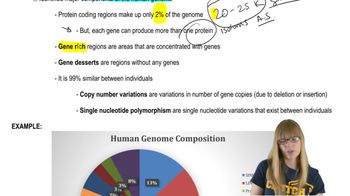
Human Genome Composition

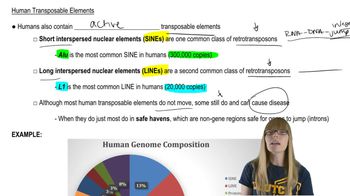
Alu Sequences and Short Interspersed Elements (SINEs)

Alu sequences are a type of SINE, approximately 282 base pairs long, repeated about one million times per haploid genome. These repetitive elements are dispersed throughout the genome and can be used as markers for genetic studies. Their abundance affects genome structure and spacing calculations.
Video consigliato:
Percorso guidato
05:30
Human Transposable Elements

Calculating Average Spacing Between Repetitive Elements

To find the average spacing between repetitive sequences, divide the total genome size by the number of repeats. This gives the average number of base pairs between each element, assuming even distribution. This concept helps estimate genomic distances between Alu sequences.
Video consigliato:
Pratica correlata
Domanda del libro di testo

The following is a diagram of the general structure of the bacteriophage chromosome. Speculate on the mechanism by which it forms a closed ring upon infection of the host cell.

654
views
Domanda del libro di testo

At the end of the short arm of human chromosome 16 (16p), several genes associated with disease are present, including thalassemia and polycystic kidney disease. When that region of chromosome 16 was sequenced, gene-coding regions were found to be very close to the telomere-associated sequences. Could there be a possible link between the location of these genes and the presence of the telomere-associated sequences? What further information concerning the disease genes would be useful in your analysis?

760
views
Domanda del libro di testo

While much remains to be learned about the role of nucleosomes and chromatin structure and function, recent research indicates that in vivo chemical modification of histones is associated with changes in gene activity. One study determined that acetylation of H3 and H4 is associated with 21.1 percent and 13.8 percent increases in yeast gene activity, respectively, and that histones associated with yeast heterochromatin are hypomethylated relative to the genome average [Bernstein et al. (2000)]. Speculate on the significance of these findings in terms of nucleosome–DNA interactions and gene activity.

800
views
Domanda del libro di testo
In a study of Drosophila, two normally active genes, w⁺ (wild-type allele of the white-eye gene) and hsp26 (a heat-shock gene), were introduced (using a plasmid vector) into euchromatic and heterochromatic chromosomal regions, and the relative activity of each gene was assessed [Sun et al. (2002)]. An approximation of the resulting data is shown in the following table. Which characteristic or characteristics of heterochromatin are supported by the experimental data? Gene Activity (relative percentage) _ Euchromatin Heterochromatin hsp26 100% 31% w⁺ 100% 8%
515
views
Domanda del libro di testo

An article entitled 'Nucleosome Positioning at the Replication Fork' states: 'both the 'old' randomly segregated nucleosomes as well as the 'new' assembled histone octamers rapidly position themselves (within seconds) on the newly replicated DNA strands' [Lucchini et al. (2002)]. Given this statement, how would one compare the distribution of nucleosomes and DNA in newly replicated chromatin? How could one experimentally test the distribution of nucleosomes on newly replicated chromosomes?

578
views
Domanda del libro di testo

Microsatellites are currently exploited as markers for paternity testing. A sample paternity test is shown in the following table in which ten microsatellite markers were used to test samples from a mother, her child, and an alleged father. The name of the microsatellite locus is given in the left-hand column, and the genotype of each individual is recorded as the number of repeats he or she carries at that locus. For example, at locus D9S302, the mother carries 30 repeats on one of her chromosomes and 31 on the other. In cases where an individual carries the same number of repeats on both chromosomes, only a single number is recorded. (Some of the numbers are followed by a decimal point, for example, 20.2, to indicate a partial repeat in addition to the complete repeats.) Assuming that these markers are inherited in a simple Mendelian fashion, can the alleged father be excluded as the source of the sperm that produced the child? Why or why not? Explain.

998
views