Ch. 13 - The Genetic Code and Transcription
Klug - Concepts of Genetics 12th Edition
Klug12th EditionConcepts of GeneticsISBN: 9780135564776Non è quello che usi tu?Cambia libro di testo
Capitolo 13, Problema 6

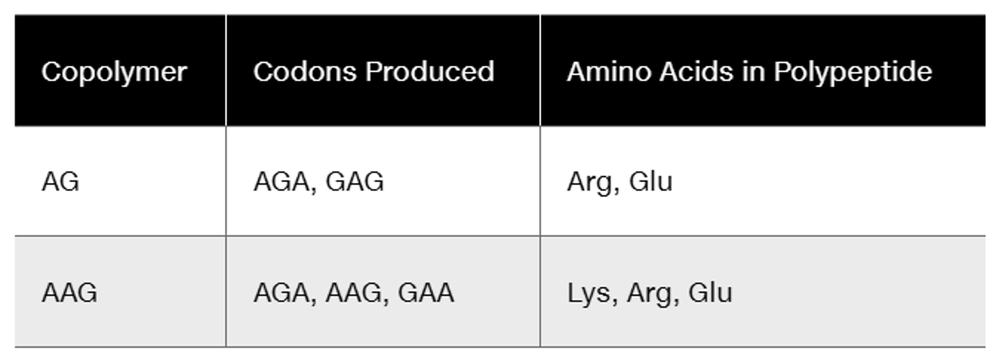
In a coding experiment using repeating copolymers, the following data were obtained:
Table showing copolymers AG and AAG with their codons and corresponding amino acids Arg, Glu, Lys.
AGG is known to code for arginine. Taking into account the wobble hypothesis, assign each of the four codons produced in the experiment to its correct amino acid.

Guida verificata passo dopo passo
1
Step 1: Identify the known codon and its amino acid. The problem states that AGG codes for arginine (Arg). This gives us a starting point to analyze other codons with similar sequences.
Step 2: Recall the wobble hypothesis, which states that the third base of a codon can often vary without changing the amino acid it codes for. This means codons differing only in the third base may code for the same amino acid.
Step 3: Analyze the codons from the AG copolymer: AGA and GAG. Since AGG codes for Arg, and AGA differs only in the third base, AGA likely also codes for Arg. GAG differs in the first base and is associated with Glu in the table, so GAG codes for Glutamic acid (Glu).
Step 4: Analyze the codons from the AAG copolymer: AGA, AAG, and GAA. From previous steps, AGA codes for Arg. AAG differs in the third base from AAA, which is known to code for Lysine (Lys), so AAG likely codes for Lys. GAA is known to code for Glu.
Step 5: Assign each codon to its amino acid based on the wobble hypothesis and the given data: AGA - Arg, GAG - Glu, AAG - Lys, GAA - Glu.

Risposta video verificata per un problema simile:

Questa soluzione video è stata consigliata dai nostri tutor come utile per risolvere questo problema.
Durata del video:
1m

Concetti chiave

Ecco i concetti essenziali che devi comprendere per rispondere correttamente alla domanda.

The Genetic Code and Codon-Amino Acid Relationship

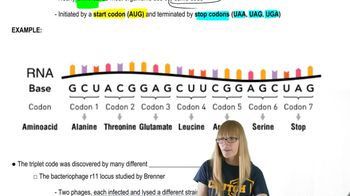
The genetic code consists of triplet codons in mRNA that specify amino acids during protein synthesis. Each codon corresponds to a particular amino acid or a stop signal. Understanding which codons code for which amino acids is essential for interpreting polypeptide sequences from nucleotide sequences.
Video consigliato:
Percorso guidato
11:43
The Genetic Code

Wobble Hypothesis

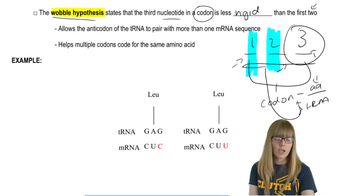
The wobble hypothesis explains that the third base of a codon can pair less strictly with the corresponding base of the tRNA anticodon, allowing some tRNAs to recognize multiple codons. This flexibility helps explain why different codons can code for the same amino acid, which is crucial for assigning codons to amino acids in the experiment.
Video consigliato:
Percorso guidato
03:13
Translation:Wobble Hypothesis

Repeating Copolymers and Codon Production

Repeating copolymers are sequences of nucleotides repeated in a pattern, producing specific sets of codons. Analyzing the codons produced by these copolymers helps identify the amino acids incorporated into the polypeptide. This concept is key to linking the experimental codons to their corresponding amino acids.
Video consigliato:
Percorso guidato
11:43
The Genetic Code
Pratica correlata
Domanda del libro di testo

In the triplet binding technique, radioactivity remains on the filter when the amino acid corresponding to the codon is labeled. Explain the rationale for this technique.

511
views
Domanda del libro di testo

When the amino acid sequences of insulin isolated from different organisms were determined, differences were noted. For example, alanine was substituted for threonine, serine for glycine, and valine for isoleucine at corresponding positions in the protein. List the single-base changes that could occur in codons of the genetic code to produce these amino acid changes.

467
views
Domanda del libro di testo

In studies of the amino acid sequence of wild-type and mutant forms of tryptophan synthetase in E. coli, the following changes have been observed:

Determine a set of triplet codes in which only a single-nucleotide change produces each amino acid change.

811
views
Domanda del libro di testo

Assuming the genetic code is a triplet, what effect would the addition or loss of two nucleotides have on the reading frame? The addition or loss of three, six, or nine nucleotides?

954
views
Domanda del libro di testo

In studies using repeating copolymers, AC . . . incorporates threonine and histidine, and CAACAA . . . incorporates glutamine, asparagine, and threonine. What triplet code can definitely be assigned to threonine?

740
views
Domanda del libro di testo

The mRNA formed from the repeating tetranucleotide UUAC incorporates only three amino acids, but the use of UAUC incorporates four amino acids. Why?

704
views