Ch. 13 - The Genetic Code and Transcription
Klug - Concepts of Genetics 12th Edition
Klug12th EditionConcepts of GeneticsISBN: 9780135564776Non è quello che usi tu?Cambia libro di testo
Capitolo 13, Problema 1b

What experimental evidence provided the initial insights into the compositions of codons encoding specific amino acids?

Guida verificata passo dopo passo
1
Understand that the question asks about the experimental evidence that first revealed how codons correspond to specific amino acids in the genetic code.
Recall that the key early experiments involved deciphering the genetic code by determining which sequences of nucleotides (codons) specify particular amino acids during protein synthesis.
Focus on the experiments by Marshall Nirenberg and Heinrich Matthaei in 1961, where they used synthetic RNA sequences in a cell-free system to direct the synthesis of polypeptides.
Note that they created artificial RNA sequences composed of repeating nucleotides, such as poly-U (uracil), and observed which amino acids were incorporated into the resulting polypeptides, linking specific codons to amino acids.
Recognize that this approach of using synthetic RNA and cell-free translation systems provided the first direct experimental evidence connecting codons to their corresponding amino acids.

Risposta video verificata per un problema simile:

Questa soluzione video è stata consigliata dai nostri tutor come utile per risolvere questo problema.
Durata del video:
2m

Concetti chiave

Ecco i concetti essenziali che devi comprendere per rispondere correttamente alla domanda.

The Genetic Code and Codons

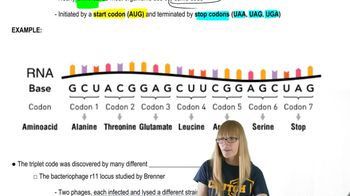
The genetic code consists of codons, which are sequences of three nucleotides in mRNA that specify particular amino acids during protein synthesis. Understanding that codons are triplets is fundamental to linking nucleotide sequences to amino acid sequences.
Video consigliato:
Percorso guidato
11:43
The Genetic Code

Nirenberg and Matthaei's Poly-U Experiment

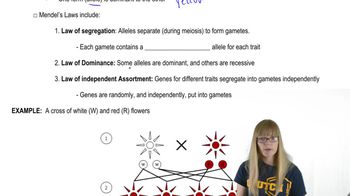
This landmark experiment used synthetic RNA composed solely of uracil bases (poly-U) to direct protein synthesis in vitro, resulting in a polypeptide of phenylalanine. It provided the first direct evidence that specific codons correspond to specific amino acids.
Video consigliato:

In Vitro Translation Systems

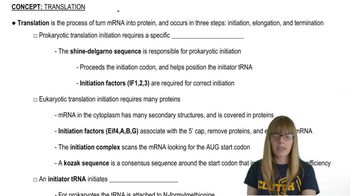
In vitro translation systems allow researchers to study protein synthesis outside living cells by providing mRNA templates and necessary components. These systems were crucial for testing synthetic RNAs and identifying which amino acids were incorporated, revealing codon assignments.
Video consigliato:
Percorso guidato
07:58
Translation initiation