Ch. 13 - The Genetic Code and Transcription
Klug - Concepts of Genetics 12th Edition
Klug12th EditionConcepts of GeneticsISBN: 9780135564776Non è quello che usi tu?Cambia libro di testo
Capitolo 13, Problema 12

Predict the amino acid sequence produced during translation by the following short hypothetical mRNA sequences (note that the second sequence was formed from the first by a deletion of only one nucleotide):
Sequence 1: 5'-AUGCCGGAUUAUAGUUGA-3'
Sequence 2: 5'-AUGCCGGAUUAAGUUGA-3'
What type of mutation gave rise to sequence 2?

Guida verificata passo dopo passo
1
Step 1: Identify the codons in Sequence 1 by dividing the mRNA sequence into groups of three nucleotides starting from the 5' end. For Sequence 1 (5'-AUGCCGGAUUAUAGUUGA-3'), the codons are: AUG, CCG, GAU, UAU, AGU, UGA.
Step 2: Translate each codon from Sequence 1 into its corresponding amino acid using the standard genetic code. Remember that AUG is the start codon (Methionine), and UGA is a stop codon signaling termination of translation.
Step 3: For Sequence 2 (5'-AUGCCGGAUUAAGUUGA-3'), note that one nucleotide has been deleted compared to Sequence 1. Divide this sequence into codons starting from the 5' end as well, grouping every three nucleotides: AUG, CCG, GAU, UAA, GUU, GA.
Step 4: Translate the codons of Sequence 2 into amino acids using the genetic code. Pay special attention to the new codons formed after the deletion, especially if a stop codon appears earlier than in Sequence 1.
Step 5: Compare the amino acid sequences from both sequences to observe the effect of the deletion. Based on the change in the reading frame and the resulting amino acid sequence, determine the type of mutation. Since the deletion shifts the reading frame, this is a frameshift mutation.

Risposta video verificata per un problema simile:

Questa soluzione video è stata consigliata dai nostri tutor come utile per risolvere questo problema.
Durata del video:
2m

Concetti chiave

Ecco i concetti essenziali che devi comprendere per rispondere correttamente alla domanda.

The Genetic Code and Translation

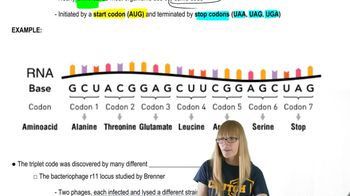
The genetic code consists of codons, groups of three nucleotides in mRNA, each specifying a particular amino acid. During translation, ribosomes read these codons sequentially to assemble a polypeptide chain. Understanding how codons correspond to amino acids is essential for predicting the protein sequence from an mRNA strand.
Video consigliato:
Percorso guidato
11:43
The Genetic Code

Frameshift Mutations

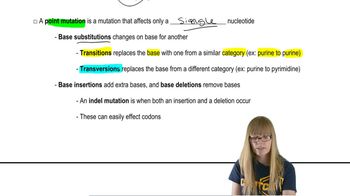
Frameshift mutations occur when nucleotides are inserted or deleted from the DNA or mRNA sequence, altering the reading frame of codons. This shift changes every downstream codon, often resulting in a completely different and nonfunctional protein. A single nucleotide deletion, as in the question, typically causes a frameshift mutation.
Video consigliato:
Percorso guidato
09:49
Point Mutations

Effects of Mutations on Protein Synthesis

Mutations can alter the amino acid sequence of a protein, potentially changing its structure and function. Deletions or insertions can cause premature stop codons or abnormal proteins. Recognizing how specific mutations affect translation helps in identifying mutation types and predicting their biological consequences.
Video consigliato: