Ch. 14 - Translation and Proteins
Klug - Concepts of Genetics 12th Edition
Klug12th EditionConcepts of GeneticsISBN: 9780135564776Non è quello che usi tu?Cambia libro di testo
Capitolo 14, Problema 30

How does an enzyme function? Why are enzymes essential for living organisms on Earth?

Guida verificata passo dopo passo
1
Understand that enzymes are biological catalysts, which means they speed up chemical reactions without being consumed in the process.
Recognize that enzymes function by lowering the activation energy required for a reaction to proceed, making it easier and faster for the reaction to occur.
Learn that enzymes have specific active sites where substrates (the molecules they act upon) bind, allowing the enzyme to facilitate the conversion of substrates into products.
Appreciate that enzymes are essential for living organisms because they regulate and accelerate vital biochemical reactions necessary for life, such as digestion, energy production, and DNA replication.
Note that without enzymes, many biochemical reactions would occur too slowly to sustain life, making enzymes crucial for maintaining the metabolism and overall functioning of living organisms.

Risposta video verificata per un problema simile:

Questa soluzione video è stata consigliata dai nostri tutor come utile per risolvere questo problema.
Durata del video:
54s

Concetti chiave

Ecco i concetti essenziali che devi comprendere per rispondere correttamente alla domanda.

Enzyme Function and Catalysis

Enzymes are biological catalysts that speed up chemical reactions by lowering the activation energy required. They bind to specific substrates at their active sites, facilitating the conversion into products without being consumed in the process.
Video consigliato:
Percorso guidato
08:26
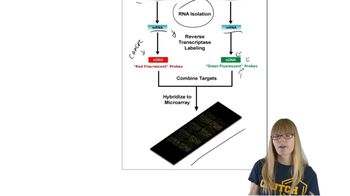
Functional Genomics

Specificity of Enzymes

Enzymes are highly specific, meaning each enzyme typically catalyzes only one type of reaction or acts on a particular substrate. This specificity ensures precise regulation of metabolic pathways in living organisms.
Video consigliato:
Percorso guidato
01:45
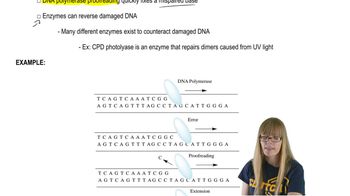
DNA Proofreading

Role of Enzymes in Living Organisms

Enzymes are essential for life because they enable vital biochemical reactions to occur rapidly and efficiently under mild conditions. Without enzymes, metabolic processes like digestion, energy production, and DNA replication would be too slow to sustain life.
Video consigliato:
Percorso guidato
09:12
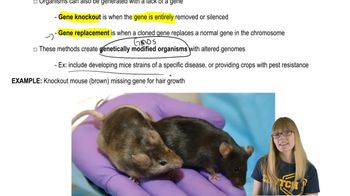
Transgenic Organisms and Gene Therapy
Pratica correlata
Domanda del libro di testo

Why are misfolded proteins a potential problem for the eukaryotic cell, and how do cells combat the accumulation of misfolded proteins?

637
views
Domanda del libro di testo

List three different types of posttranslational modifications that may happen to a protein and the significance of each in the context of protein function.

444
views
Domanda del libro di testo

Three independently assorting genes (A, B, and C) are known to control the following biochemical pathway that provides the basis for flower color in a hypothetical plant:

Three homozygous recessive mutations are also known, each of which interrupts a different one of these steps. Determine the phenotypic results in the F1 and F2 generations resulting from the P1 crosses of true-breeding plants listed here:

speckled (AABBCC) × yellow (AAbbCC)

847
views
Domanda del libro di testo

Exon shuffling is a proposal that relates exons in DNA to the repositioning of functional domains in proteins. What evidence exists in support of exon shuffling?

905
views
Domanda del libro di testo

List as many different categories of protein functions as you can. Wherever possible, give an example of each category.

685
views
Domanda del libro di testo

Three independently assorting genes (A, B, and C) are known to control the following biochemical pathway that provides the basis for flower color in a hypothetical plant:

Three homozygous recessive mutations are also known, each of which interrupts a different one of these steps. Determine the phenotypic results in the F1 and F2 generations resulting from the P1 crosses of true-breeding plants listed here:

yellow (AAbbCC) × green (AABBcc)

531
views