Ch. 15 - Gene Mutation, DNA Repair, and Transposition
Klug - Concepts of Genetics 12th Edition
Klug12th EditionConcepts of GeneticsISBN: 9780135564776Non è quello che usi tu?Cambia libro di testo
Capitolo 15, Problema 14

Contrast the various types of DNA repair mechanisms known to counteract the effects of UV radiation. What is the role of visible light in repairing UV-induced mutations?

Guida verificata passo dopo passo
1
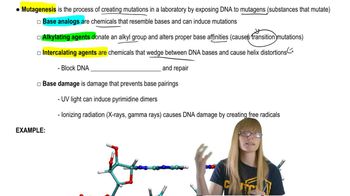
Begin by identifying the main types of DNA damage caused by UV radiation, such as the formation of thymine dimers, which distort the DNA helix and block replication.
Describe the different DNA repair mechanisms that cells use to fix UV-induced damage, including nucleotide excision repair (NER), base excision repair (BER), and direct repair mechanisms like photoreactivation.
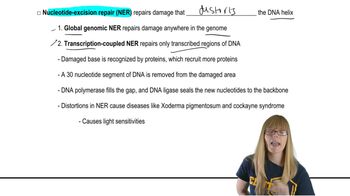
Explain nucleotide excision repair (NER) in detail: how it recognizes bulky lesions like thymine dimers, excises a short single-stranded DNA segment containing the damage, and fills in the gap using DNA polymerase and ligase.
Discuss photoreactivation, a direct repair mechanism where the enzyme photolyase uses energy from visible light to break the bonds of thymine dimers, restoring the original DNA structure without excision.
Clarify the specific role of visible light in photoreactivation: it activates photolyase, enabling it to reverse UV-induced thymine dimers efficiently, which is a unique repair pathway dependent on light energy.

Risposta video verificata per un problema simile:

Questa soluzione video è stata consigliata dai nostri tutor come utile per risolvere questo problema.
Durata del video:
2m

Concetti chiave

Ecco i concetti essenziali che devi comprendere per rispondere correttamente alla domanda.

Types of DNA Repair Mechanisms

DNA repair mechanisms are cellular processes that correct damage to DNA molecules. Key types include direct repair, excision repair (base excision and nucleotide excision), mismatch repair, and recombinational repair. Each mechanism targets specific types of damage to maintain genomic integrity.
Video consigliato:
Percorso guidato
05:44
Repair Pathways

UV-Induced DNA Damage

Ultraviolet (UV) radiation primarily causes DNA damage by inducing the formation of pyrimidine dimers, such as thymine dimers, which distort the DNA helix and block replication. Understanding this damage is essential to grasp why specific repair pathways are activated.
Video consigliato:
Percorso guidato
04:29
Induced Mutations

Role of Visible Light in Photoreactivation

Visible light drives photoreactivation, a direct repair process where the enzyme photolyase absorbs light energy to break the bonds of UV-induced pyrimidine dimers. This light-dependent repair reverses mutations without excision, highlighting the unique role of visible light in DNA repair.
Video consigliato:
Pratica correlata
Domanda del libro di testo

Why are X rays more potent mutagens than UV radiation?

932
views
Domanda del libro di testo
DNA damage brought on by a variety of natural and artificial agents elicits a wide variety of cellular responses involving numerous signaling pathways. In addition to the activation of DNA repair mechanisms, there can be activation of pathways leading to apoptosis (programmed cell death) and cell-cycle arrest. Why would apoptosis and cell-cycle arrest often be part of a cellular response to DNA damage?
863
views
Domanda del libro di testo

Mammography is an accurate screening technique for the early detection of breast cancer in humans. Because this technique uses X rays diagnostically, it has been highly controversial. Can you explain why? What reasons justify the use of X rays for such a medical screening technique?

605
views
Domanda del libro di testo

Describe how the Ames test screens for potential environmental mutagens. Why is it thought that a compound that tests positively in the Ames test may also be carcinogenic?

1022
views
Domanda del libro di testo

A significant number of mutations in the HBB gene that cause human β-thalassemia occur within introns or in upstream noncoding sequences. Explain why mutations in these regions often lead to severe disease, although they may not directly alter the coding regions of the gene.

712
views
Domanda del libro di testo

Why are frameshift mutations likely to be more detrimental than point mutations, in which a single pyrimidine or purine has been substituted?

753
views