Ch. 15 - Gene Mutation, DNA Repair, and Transposition
Klug - Concepts of Genetics 12th Edition
Klug12th EditionConcepts of GeneticsISBN: 9780135564776Non è quello che usi tu?Cambia libro di testo
Capitolo 15, Problema 1a

How do we know that mutations occur randomly?

Guida verificata passo dopo passo
1
Understand the concept of random mutations: Mutations are changes in the DNA sequence that occur without a specific purpose or direction. They are not influenced by the needs of the organism but arise due to errors in DNA replication, environmental factors, or spontaneous chemical changes.
Review the Luria-Delbrück fluctuation test: This classic experiment demonstrated that mutations occur randomly rather than as a response to environmental pressures. In the experiment, bacterial cultures were exposed to a virus, and the distribution of resistant colonies was analyzed.
Analyze the results of the fluctuation test: If mutations occurred in response to the virus, all bacterial cultures would show similar numbers of resistant colonies. However, the experiment showed a wide variation in the number of resistant colonies across cultures, supporting the idea that mutations occurred randomly before exposure to the virus.
Understand the role of replica plating: This technique further confirmed the randomness of mutations. Bacteria were grown on a master plate, and colonies were transferred to plates containing antibiotics. Resistant colonies were found in the same positions on all plates, indicating that the mutations conferring resistance occurred before exposure to the antibiotic.
Connect the evidence to the concept of randomness: These experiments collectively demonstrate that mutations arise independently of environmental conditions, supporting the idea that mutations occur randomly rather than as a directed response to environmental challenges.

Risposta video verificata per un problema simile:

Questa soluzione video è stata consigliata dai nostri tutor come utile per risolvere questo problema.
Durata del video:
29s

Concetti chiave

Ecco i concetti essenziali che devi comprendere per rispondere correttamente alla domanda.

Gene Mutations

Gene mutations are changes in the DNA sequence of an organism's genome. These alterations can occur due to various factors, including errors during DNA replication, environmental influences, or spontaneous chemical changes. Understanding the nature of these mutations is crucial for studying genetic variation and evolution.
Video consigliato:
Percorso guidato
04:46
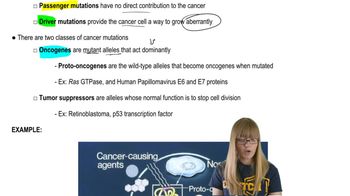
Cancer Mutations

Randomness of Mutations

The randomness of mutations refers to the idea that mutations occur without any specific direction or purpose, often influenced by chance rather than adaptive needs. This concept is supported by statistical analyses showing that mutations arise at a consistent rate across different genes and organisms, indicating that they are not selectively induced.
Video consigliato:
Percorso guidato
09:49
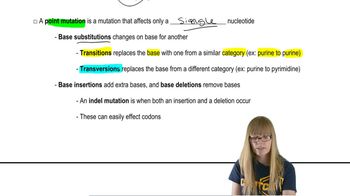
Point Mutations

DNA Repair Mechanisms

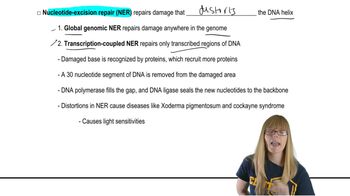
DNA repair mechanisms are cellular processes that correct damage to the DNA molecule, ensuring genomic stability. These mechanisms, such as nucleotide excision repair and mismatch repair, help maintain the integrity of the genetic material. Understanding these processes is essential for comprehending how cells manage mutations and their potential consequences.
Video consigliato:
Percorso guidato
05:44
Repair Pathways