Ch. 16 - Regulation of Gene Expression in Bacteria
Klug - Concepts of Genetics 12th Edition
Klug12th EditionConcepts of GeneticsISBN: 9780135564776Non è quello che usi tu?Cambia libro di testo
Capitolo 16, Problema 24

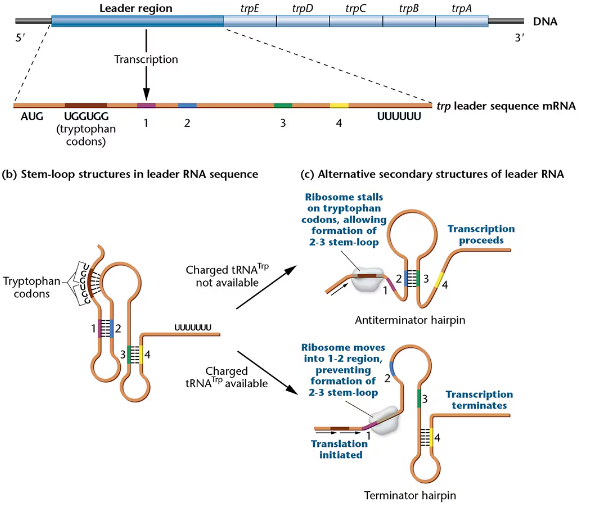
The following figure depicts numerous critical regions of the leader sequence of mRNA that play important roles during the process of attenuation in the trp operon. A closer view of the leader sequence, which begins at about position 30 downstream from the 5' end, is shown below, running along both columns. Within this molecule are the sequences that cause the formation of the alternative hairpins. It also contains the successive triplets that encode tryptophan, where stalling during translation occurs.
Take a large piece of paper (such as manila wrapping paper) and, along with several other students from your genetics class, work through the base sequence to identify the trp codons and the parts of the molecule representing the base-pairing regions that form the terminator and antiterminator hairpins shown in the following figure.
Diagram showing leader mRNA sequence with tryptophan codons and stem-loop structures forming antiterminator and terminator hairpins.

Guida verificata passo dopo passo
1
Understand the context of the problem: The trp operon is a regulatory mechanism in prokaryotes, specifically in *E. coli*, that controls the synthesis of tryptophan. Attenuation is a process that regulates transcription termination based on the availability of tryptophan. The leader sequence of the mRNA contains regions that can form alternative secondary structures (hairpins) influencing transcription.
Locate the trp codons in the leader sequence: Carefully examine the provided base sequence of the leader region. Identify the triplets that encode tryptophan (UGG codons). These codons are critical because they are the sites where ribosome stalling occurs during low tryptophan levels.
Identify the regions that form the terminator and antiterminator hairpins: Look for complementary base-pairing regions within the leader sequence. The terminator hairpin typically forms when tryptophan levels are high, leading to transcription termination. The antiterminator hairpin forms when tryptophan levels are low, allowing transcription to continue.
Analyze the sequence to determine the conditions for hairpin formation: The terminator hairpin is usually followed by a string of uracils (U) and forms when the ribosome does not stall at the trp codons. The antiterminator hairpin forms when the ribosome stalls at the trp codons due to low tryptophan levels, preventing the terminator hairpin from forming.
Collaborate with your classmates to map the sequence: Use a large piece of paper to visually represent the leader sequence. Mark the trp codons and the regions that can form the hairpins. Discuss with your classmates how the sequence structure changes under different tryptophan conditions and how this affects transcription of the trp operon.

Risposta video verificata per un problema simile:

Questa soluzione video è stata consigliata dai nostri tutor come utile per risolvere questo problema.
Durata del video:
35s

Concetti chiave

Ecco i concetti essenziali che devi comprendere per rispondere correttamente alla domanda.

trp Operon

The trp operon is a group of genes in bacteria that are involved in the biosynthesis of the amino acid tryptophan. It is regulated through a mechanism called attenuation, which allows the cell to respond to the levels of tryptophan. When tryptophan is abundant, the operon is turned off, while low levels of tryptophan lead to its activation. Understanding the trp operon is crucial for grasping how gene expression is controlled in prokaryotes.
Video consigliato:
Percorso guidato
09:11
Trp Attenuation

mRNA Leader Sequence

The leader sequence of mRNA is a short region at the beginning of the mRNA transcript that plays a key role in regulating gene expression. In the context of the trp operon, this sequence contains specific codons for tryptophan and is involved in the formation of secondary structures, such as hairpins. These structures can either promote or inhibit the continuation of transcription, depending on the availability of tryptophan, making the leader sequence essential for the attenuation process.
Video consigliato:
Percorso guidato
08:41
Sequencing Difficulties

Hairpin Structures

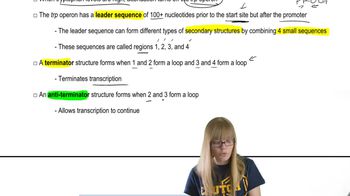
Hairpin structures are formed when complementary sequences within a single strand of RNA base-pair with each other, creating a loop. In the trp operon, the formation of alternative hairpins in the leader sequence determines whether transcription will continue or terminate. The presence of a terminator hairpin signals the RNA polymerase to stop transcription, while an antiterminator hairpin allows transcription to proceed, illustrating the dynamic regulation of gene expression.
Video consigliato:
Percorso guidato
03:49
Ribosome Structure
Pratica correlata
Domanda del libro di testo

The SOS repair genes in E. coli are negatively regulated by the lexA gene product, called the LexA repressor. When a cell's DNA sustains extensive damage, the LexA repressor is inactivated by the recA gene product (RecA), and transcription of the SOS genes is increased dramatically. One of the SOS genes is the uvrA gene. You are a student studying the function of the UvrA gene product in DNA repair. You isolate a mutant strain that shows constitutive expression of the UvrA protein. Naming this mutant strain uvrAᶜ, you construct the diagram shown above in the right-hand column showing the lexA and uvrA operons:

Describe two different mutations that would result in a uvrA constitutive phenotype. Indicate the actual genotypes involved.

959
views
Domanda del libro di testo

The SOS repair genes in E. coli are negatively regulated by the lexA gene product, called the LexA repressor. When a cell's DNA sustains extensive damage, the LexA repressor is inactivated by the recA gene product (RecA), and transcription of the SOS genes is increased dramatically. One of the SOS genes is the uvrA gene. You are a student studying the function of the uvrA gene product in DNA repair. You isolate a mutant strain that shows constitutive expression of the UvrA protein. Naming this mutant strain uvrAC, you construct the diagram shown above in the right-hand column showing the lexA and uvrA operons:

Outline a series of genetic experiments that would use partial diploid strains to determine which of the two possible mutations you have isolated.

884
views
Domanda del libro di testo

A fellow student considers the issues in Problem 22 and argues that there is a more straightforward, nongenetic experiment that could differentiate between the two types of mutations. The experiment requires no fancy genetics and would allow you to easily assay the products of the other SOS genes. Propose such an experiment.

498
views