Ch. 20 - Recombinant DNA Technology
Klug - Concepts of Genetics 12th Edition
Klug12th EditionConcepts of GeneticsISBN: 9780135564776Non è quello che usi tu?Cambia libro di testo
Capitolo 20, Problema 4

The human insulin gene contains a number of sequences that are removed in the processing of the mRNA transcript. In spite of the fact that bacterial cells cannot excise these sequences from mRNA transcripts, explain how a gene like this can be cloned into a bacterial cell and produce insulin.

Guida verificata passo dopo passo
1
Understand that the human insulin gene contains introns, which are non-coding sequences removed during mRNA processing in eukaryotic cells but not in bacteria, as bacteria lack the machinery to splice out introns.
Recognize that to express the insulin gene in bacteria, the gene must be in a form that bacteria can read directly, meaning it should not contain introns.
Use the mature mRNA transcript of the insulin gene, which has already had the introns removed, as a template to synthesize complementary DNA (cDNA) using the enzyme reverse transcriptase.
Clone this cDNA, which represents the intron-free coding sequence of the insulin gene, into a bacterial plasmid vector that contains the necessary regulatory sequences for bacterial expression.
Transform the recombinant plasmid into bacterial cells, which can then transcribe and translate the cDNA to produce functional insulin protein, since the bacterial machinery can now read the intron-free sequence.

Risposta video verificata per un problema simile:

Questa soluzione video è stata consigliata dai nostri tutor come utile per risolvere questo problema.
Durata del video:
1m

Concetti chiave

Ecco i concetti essenziali che devi comprendere per rispondere correttamente alla domanda.

Gene Structure: Exons and Introns

Eukaryotic genes often contain exons (coding regions) and introns (non-coding regions). During mRNA processing, introns are removed through splicing to produce a mature mRNA that can be translated into protein. Bacteria lack the machinery to remove introns, so direct expression of eukaryotic genes with introns in bacteria is problematic.
Video consigliato:
Percorso guidato
03:49
Ribosome Structure

cDNA and Reverse Transcription

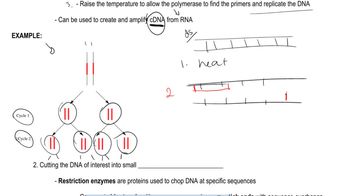
Complementary DNA (cDNA) is synthesized from mature mRNA using reverse transcriptase. cDNA contains only exons, lacking introns, making it suitable for cloning into bacterial cells. Using cDNA ensures that bacteria can transcribe and translate the gene correctly to produce functional protein.
Video consigliato:
Percorso guidato
09:16
Eukaryotic Transcription

Recombinant DNA Technology and Cloning in Bacteria

Recombinant DNA technology allows insertion of cDNA into bacterial plasmids, which are then introduced into bacterial cells. Bacteria can transcribe and translate the inserted cDNA to produce the desired protein, such as insulin, despite lacking splicing mechanisms. This method enables production of eukaryotic proteins in prokaryotic hosts.
Video consigliato:
Percorso guidato
07:39
Genetic Cloning