Ch. 20 - Recombinant DNA Technology
Klug - Concepts of Genetics 12th Edition
Klug12th EditionConcepts of GeneticsISBN: 9780135564776Non è quello che usi tu?Cambia libro di testo
Capitolo 20, Problema 33b

The U.S. Department of Justice has established a database that catalogs PCR amplification products from short tandem repeats of the Y chromosome (Y-STRs) in humans. The database contains polymorphisms of five U.S. ethnic groups (African-Americans, European Americans, Hispanics, Native Americans, and Asian-Americans) as well as the worldwide population.
Y-STRs from the nonrecombining region of the Y chromosome (NRY) have special relevance for forensic purposes. Why?

Guida verificata passo dopo passo
1
Understand the concept of Y-STRs: Y-STRs (short tandem repeats on the Y chromosome) are specific sequences of DNA that are repeated multiple times and are located in the nonrecombining region of the Y chromosome (NRY). These regions are inherited paternally and do not undergo recombination, making them stable markers for tracing male lineage.
Recognize the forensic relevance of Y-STRs: Since Y-STRs are passed down from father to son without recombination, they can be used to identify male individuals or male lineage in forensic investigations. This is particularly useful in cases where male-specific DNA evidence is required, such as sexual assault cases or determining paternity.
Consider the population database: The U.S. Department of Justice database catalogs Y-STR polymorphisms across various ethnic groups and the worldwide population. This allows forensic scientists to compare Y-STR profiles from crime scene evidence to profiles in the database, aiding in identification or exclusion of suspects.
Understand the limitations and advantages: Y-STRs are specific to males, so they cannot provide information about female individuals. However, their stability and paternal inheritance make them highly reliable for tracing male lineage and identifying male contributors in mixed DNA samples.
Apply the concept to forensic cases: In forensic science, Y-STR analysis is used to match DNA evidence from a crime scene to a suspect or to establish familial relationships. The nonrecombining nature of the Y chromosome ensures that the Y-STR profile remains consistent across generations, making it a powerful tool for male-specific investigations.

Risposta video verificata per un problema simile:

Questa soluzione video è stata consigliata dai nostri tutor come utile per risolvere questo problema.
Durata del video:
22s

Concetti chiave

Ecco i concetti essenziali che devi comprendere per rispondere correttamente alla domanda.

Y-STRs (Y Chromosome Short Tandem Repeats)

Y-STRs are specific regions on the Y chromosome that consist of repeating sequences of DNA. These regions are inherited paternally, making them particularly useful in tracing lineage and ancestry. In forensic science, Y-STRs can help identify male individuals in mixed DNA samples, as they are present only in males.
Video consigliato:
Percorso guidato
10:35
Human Sex Chromosomes

Non-Recombining Region of the Y Chromosome (NRY)

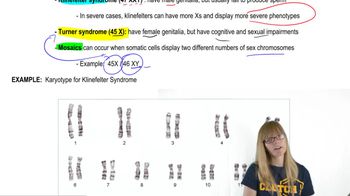
The non-recombining region of the Y chromosome (NRY) is a segment that does not undergo recombination during meiosis. This stability allows for the preservation of Y-STRs across generations, making them reliable markers for paternal lineage studies. In forensic contexts, NRY analysis can provide insights into male ancestry without the complications of genetic mixing from females.
Video consigliato:
Percorso guidato
00:30
Regions of X Chromosomes

Forensic Genetics

Forensic genetics involves the application of genetic analysis to legal investigations, particularly in identifying individuals from biological samples. The use of Y-STRs in forensic genetics is crucial for cases involving male suspects or victims, as it allows for the differentiation of male DNA in mixed samples. This specificity enhances the accuracy of forensic evidence in criminal cases.
Video consigliato:
Percorso guidato
03:45
Descriptive Genetics
Pratica correlata
Domanda del libro di testo

The U.S. Department of Justice has established a database that catalogs PCR amplification products from short tandem repeats of the Y chromosome (Y-STRs) in humans. The database contains polymorphisms of five U.S. ethnic groups (African-Americans, European Americans, Hispanics, Native Americans, and Asian-Americans) as well as the worldwide population.

For forensic applications, the probability of a 'match' for a crime scene DNA sample and a suspect's DNA often culminates in a guilty or innocent verdict. How is a 'match' determined, and what are the uses and limitations of such probabilities?

464
views
Domanda del libro di testo

In humans, congenital heart disease is a common birth defect that affects approximately 1 out of 125 live births. Using reverse transcription PCR (RT-PCR), Samir Zaidi and colleagues [(2013) Nature 498:220.223] determined that approximately 10 percent of the cases resulted from point mutations, often involving histone function. To capture products of gene expression in developing hearts, they used oligo(dT) in their reverse transcription protocol.

If one were interested in comparing the quantitative distribution of gene expression in, say, the right and left sides of a developing heart, how might one proceed using RT-PCR?

605
views
Domanda del libro di testo

There are a variety of circumstances under which rapid results using multiple markers in PCR amplifications are highly desired, such as in forensics, pathogen analysis, or detection of genetically modified organisms. In multiplex PCR, multiple sets of primers are used, often with less success than when applied to PCR as individual sets. Numerous studies have been conducted to optimize procedures, but each has described the process as time consuming and often unsuccessful. Considering the information given in Problem 30, why should multiplex PCR be any different than single primer set PCR in terms of dependability and ease of optimization?

416
views
Domanda del libro di testo

In humans, congenital heart disease is a common birth defect that affects approximately 1 out of 125 live births. Using reverse transcription PCR (RT-PCR), Samir Zaidi and colleagues [(2013) Nature 498:220.223] determined that approximately 10 percent of the cases resulted from point mutations, often involving histone function. To capture products of gene expression in developing hearts, they used oligo(dT) in their reverse transcription protocol.

Compared with oligo(dT) primers, a pool of random sequence primers requires a trickier assessment of annealing temperature. Why?

489
views
Domanda del libro di testo

The U.S. Department of Justice has established a database that catalogs PCR amplification products from short tandem repeats of the Y chromosome (Y-STRs) in humans. The database contains polymorphisms of five U.S. ethnic groups (African-Americans, European Americans, Hispanics, Native Americans, and Asian-Americans) as well as the worldwide population.

Given that STRs are repeats of varying lengths, for example (TCTG)₉₋₁₇ or (TAT)₆₋₁₄, explain how PCR could reveal differences (polymorphisms) among individuals. How could the Department of Justice make use of those differences?

488
views
Domanda del libro di testo

The U.S. Department of Justice has established a database that catalogs PCR amplification products from short tandem repeats of the Y chromosome (Y-STRs) in humans. The database contains polymorphisms of five U.S. ethnic groups (African-Americans, European Americans, Hispanics, Native Americans, and Asian-Americans) as well as the worldwide population.

What would be the value of knowing the ethnic population differences for Y-STR polymorphisms?

537
views