Ch. 20 - Recombinant DNA Technology
Klug - Concepts of Genetics 12th Edition
Klug12th EditionConcepts of GeneticsISBN: 9780135564776Non è quello che usi tu?Cambia libro di testo
Capitolo 20, Problema 21

Traditional Sanger sequencing has largely been replaced in recent years by next-generation and third-generation sequencing approaches. Describe advantages of these sequencing methods over first-generation Sanger sequencing.

Guida verificata passo dopo passo
1
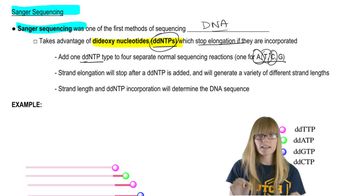
Step 1: Understand the basics of Sanger sequencing, which is a first-generation sequencing method that sequences DNA by incorporating chain-terminating dideoxynucleotides during DNA synthesis, producing fragments of varying lengths that are then separated by electrophoresis to determine the sequence.
Step 2: Identify key limitations of Sanger sequencing, such as relatively low throughput (sequencing one DNA fragment at a time), higher cost per base, and longer time required for sequencing large genomes.
Step 3: Explore next-generation sequencing (NGS) methods, which allow massively parallel sequencing of millions of DNA fragments simultaneously, greatly increasing throughput and reducing cost per base compared to Sanger sequencing.
Step 4: Examine third-generation sequencing technologies, which can sequence single DNA molecules in real-time without the need for amplification, providing longer read lengths and faster turnaround times, which help resolve complex genomic regions and structural variants.
Step 5: Summarize the advantages of next- and third-generation sequencing over Sanger sequencing, including higher throughput, lower cost per base, faster sequencing times, ability to sequence whole genomes efficiently, and improved detection of complex genetic variations.

Risposta video verificata per un problema simile:

Questa soluzione video è stata consigliata dai nostri tutor come utile per risolvere questo problema.
Durata del video:
59s

Concetti chiave

Ecco i concetti essenziali che devi comprendere per rispondere correttamente alla domanda.

Sanger Sequencing (First-Generation Sequencing)

Sanger sequencing is a DNA sequencing method that uses chain-terminating dideoxynucleotides to generate DNA fragments of varying lengths. It provides high accuracy but is relatively low-throughput and time-consuming, making it less suitable for large-scale genome projects.
Video consigliato:
Percorso guidato
04:12
Sanger Sequencing

Next-Generation Sequencing (NGS)

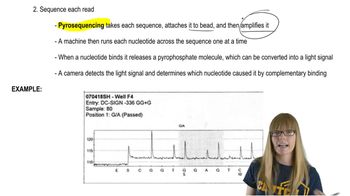
Next-generation sequencing refers to high-throughput technologies that allow simultaneous sequencing of millions of DNA fragments. NGS offers faster, more cost-effective sequencing with massive parallelization, enabling whole-genome and transcriptome analysis at unprecedented scale.
Video consigliato:
Percorso guidato
08:41
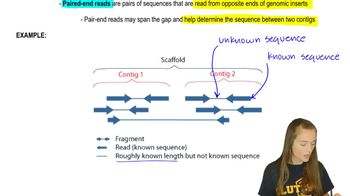
Sequencing Difficulties

Third-Generation Sequencing

Third-generation sequencing technologies sequence single DNA molecules in real-time without amplification, producing longer reads than NGS. This approach improves genome assembly, detects structural variants, and reduces biases associated with amplification steps.
Video consigliato:
Percorso guidato
08:55
Sequencing Overview