
Ch. 23 - Developmental Genetics
Klug - Concepts of Genetics 12th Edition
Klug12th EditionConcepts of GeneticsISBN: 9780135564776Non è quello che usi tu?Cambia libro di testo
Capitolo 23, Problema 1b

In the discussion, we have focused on large-scale as well as the inter- and intracellular events that take place during embryogenesis and the formation of adult structures. In particular, we discussed how the adult body plan is laid down by a cascade of gene expression, and the role of cell–cell communication in development. Based on your knowledge of these topics, answer several fundamental questions:
How do we know that molecular gradients in the egg of Drosophila exist?

Guida verificata passo dopo passo
1
Understand the concept of molecular gradients: Molecular gradients refer to the uneven distribution of molecules, such as proteins or mRNA, within a cell or organism. In Drosophila eggs, these gradients are crucial for establishing the body plan during embryogenesis.
Learn about the role of maternal effect genes: Maternal effect genes, such as bicoid and nanos, are expressed in the mother and deposited into the egg. These genes create molecular gradients that guide the development of the embryo.
Explore experimental evidence: Scientists have used techniques like in situ hybridization and immunostaining to visualize the distribution of mRNA and proteins in Drosophila eggs. These methods reveal the presence of molecular gradients, such as the bicoid protein gradient concentrated at the anterior end of the egg.
Understand functional studies: Researchers have performed genetic experiments, such as mutating maternal effect genes, to observe the effects on embryonic development. For example, mutations in the bicoid gene result in embryos lacking anterior structures, confirming the role of molecular gradients in development.
Consider the role of cell signaling: Molecular gradients in the egg are interpreted by embryonic cells through signaling pathways, which activate specific genes and establish the body plan. This cascade of gene expression is essential for proper development and is supported by experimental data.

Risposta video verificata per un problema simile:

Questa soluzione video è stata consigliata dai nostri tutor come utile per risolvere questo problema.
Durata del video:
2m

Concetti chiave

Ecco i concetti essenziali che devi comprendere per rispondere correttamente alla domanda.

Molecular Gradients

Molecular gradients refer to the uneven distribution of molecules, such as proteins or mRNA, within a cell or tissue. In the context of Drosophila embryogenesis, these gradients are crucial for establishing polarity and guiding the development of body structures. They influence gene expression patterns and cell fate decisions during early development.
Video consigliato:
Percorso guidato
07:11
Mapping with Markers

Gene Expression Cascade

A gene expression cascade is a series of regulatory events where the expression of one gene triggers the expression of another, leading to a coordinated response in cellular development. In Drosophila, this cascade is essential for the proper formation of the body plan, as it dictates the timing and location of developmental processes based on the molecular gradients present.
Video consigliato:
Percorso guidato
02:09
Penetrance and Expressivity

Cell–Cell Communication

Cell–cell communication involves signaling mechanisms that allow cells to interact and coordinate their activities during development. In Drosophila, this communication is vital for interpreting molecular gradients and ensuring that cells respond appropriately to their environment, which is essential for the correct formation of tissues and organs during embryogenesis.
Video consigliato:
Percorso guidato
03:52
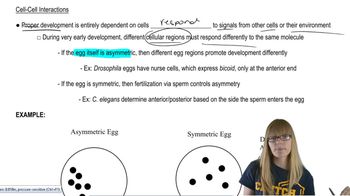
Cell-cell interactions
Pratica correlata
Domanda del libro di testo

In the discussion, we have focused on large-scale as well as the inter- and intracellular events that take place during embryogenesis and the formation of adult structures. In particular, we discussed how the adult body plan is laid down by a cascade of gene expression, and the role of cell–cell communication in development. Based on your knowledge of these topics, answer several fundamental questions:

How did we discover that selector genes specify which adult structures will be formed by body segments?

372
views
Domanda del libro di testo

In the discussion, we have focused on large-scale as well as the inter- and intracellular events that take place during embryogenesis and the formation of adult structures. In particular, we discussed how the adult body plan is laid down by a cascade of gene expression, and the role of cell–cell communication in development. Based on your knowledge of these topics, answer several fundamental questions:

How did we learn about the levels of gene regulation involved in vulval development in C. elegans?

436
views
Domanda del libro di testo

In the discussion, we have focused on large-scale as well as the inter- and intracellular events that take place during embryogenesis and the formation of adult structures. In particular, we discussed how the adult body plan is laid down by a cascade of gene expression, and the role of cell–cell communication in development. Based on your knowledge of these topics, answer several fundamental questions:

How do we know that eye formation in all animals is controlled by a binary switch gene?

406
views
Domanda del libro di testo

In the discussion, we have focused on large-scale as well as the inter- and intracellular events that take place during embryogenesis and the formation of adult structures. In particular, we discussed how the adult body plan is laid down by a cascade of gene expression, and the role of cell–cell communication in development. Based on your knowledge of these topics, answer several fundamental questions:

How have we discovered that specific genes control development in an organism like Drosophila?

410
views