Ch. 23 - Developmental Genetics
Klug - Concepts of Genetics 12th Edition
Klug12th EditionConcepts of GeneticsISBN: 9780135564776Non è quello che usi tu?Cambia libro di testo
Capitolo 23, Problema 23a

Much of what we know about gene interactions in development has been learned using nematodes, yeast, flies, and bacteria. This is due, in part, to the relative ease of genetic manipulation of these well-characterized genomes. However, of great interest are gene interactions involving complex diseases in humans. Wang and White [(2011). Nature Methods 8(4):341–346] describe work using RNAi to examine the interactive proteome in mammalian cells. They mention that knockdown inefficiencies and off-target effects of introduced RNAi species are areas that need particular improvement if the methodology is to be fruitful.
How might one use RNAi to study developmental pathways?

Guida verificata passo dopo passo
1
Understand that RNA interference (RNAi) is a technique used to reduce or 'knock down' the expression of specific genes by targeting their messenger RNA (mRNA) for degradation, thereby preventing protein production.
Identify the gene or genes of interest involved in a developmental pathway that you want to study, focusing on those suspected to play key roles in development.
Design or obtain RNAi molecules (such as small interfering RNAs, siRNAs) that specifically target the mRNA transcripts of these genes to reduce their expression in the cells or organism under study.
Introduce the RNAi molecules into the cells or model organism at appropriate developmental stages, then observe and analyze the resulting phenotypic changes or disruptions in the developmental process to infer gene function and interactions.
Control for potential off-target effects and incomplete knockdown by including proper experimental controls and possibly using multiple RNAi sequences targeting the same gene to validate the observed effects.

Risposta video verificata per un problema simile:

Questa soluzione video è stata consigliata dai nostri tutor come utile per risolvere questo problema.
Durata del video:
2m

Concetti chiave

Ecco i concetti essenziali che devi comprendere per rispondere correttamente alla domanda.

RNA Interference (RNAi) Mechanism

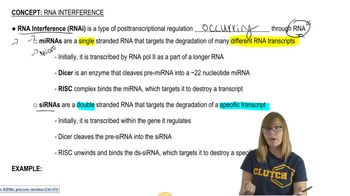
RNAi is a biological process where small RNA molecules inhibit gene expression by degrading specific mRNA transcripts. This targeted knockdown allows researchers to reduce or silence the expression of particular genes, making it a powerful tool to study gene function in developmental pathways.
Video consigliato:
Percorso guidato
06:59
RNA Interference

Gene Interactions in Developmental Pathways

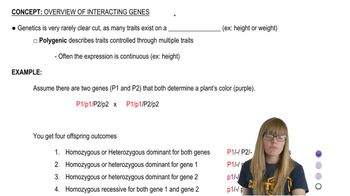
Developmental pathways involve networks of genes that regulate cell differentiation and organismal growth. Understanding how genes interact helps reveal the roles of individual genes and their combined effects, which can be studied by selectively silencing genes using RNAi to observe resulting phenotypic changes.
Video consigliato:
Percorso guidato
07:56
Interacting Genes Overview

Challenges of RNAi in Mammalian Cells

RNAi in mammalian cells faces challenges such as incomplete gene knockdown and off-target effects, where unintended genes are silenced. These issues can complicate data interpretation, so improving RNAi specificity and efficiency is crucial for accurately studying gene functions in complex developmental pathways.
Video consigliato:
Percorso guidato
03:52
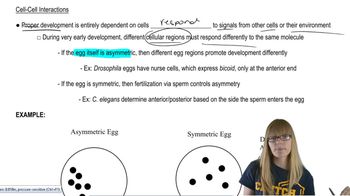
Cell-cell interactions
Pratica correlata
Domanda del libro di testo

Much of what we know about gene interactions in development has been learned using nematodes, yeast, flies, and bacteria. This is due, in part, to the relative ease of genetic manipulation of these well-characterized genomes. However, of great interest are gene interactions involving complex diseases in humans. Wang and White [(2011). Nature Methods 8(4):341–346] describe work using RNAi to examine the interactive proteome in mammalian cells. They mention that knockdown inefficiencies and off-target effects of introduced RNAi species are areas that need particular improvement if the methodology is to be fruitful.

Comment on how 'knockdown inefficiencies' and 'off-target effects' would influence the interpretation of results.

637
views
Domanda del libro di testo

Vulval development in C. elegans is dependent on the response of some of the central epidermal progenitor cells in the region of the developing vulva to a chemical signal from the gonad. Signaling from the gonad is blocked by action of the vulvaless mutant let-23 so that none of the central progenitor cells form vulval structures. In the vulvaless mutant, n300, the central progenitor cells do not form.

What phenotype (vulva formed or vulvaless) would you expect from the double mutant? Why?

765
views
Domanda del libro di testo

The floral homeotic genes of Arabidopsis belong to the MADS-box gene family, while in Drosophila, homeotic genes belong to the homeobox gene family. In both Arabidopsis and Drosophila, members of the Polycomb gene family control expression of these divergent homeotic genes. How do Polycomb genes control expression of two very different sets of homeotic genes?

575
views
Domanda del libro di testo

Dominguez et al. (2004) suggest that by studying genes that determine growth and tissue specification in the eye of Drosophila, much can be learned about human eye development.

What evidence indicates that the eyeless gene is part of a developmental network?

387
views
Domanda del libro di testo

Vulval development in C. elegans is dependent on the response of some of the central epidermal progenitor cells in the region of the developing vulva to a chemical signal from the gonad. Signaling from the gonad is blocked by action of the vulvaless mutant let-23 so that none of the central progenitor cells form vulval structures. In the vulvaless mutant, n300, the central progenitor cells do not form.

Which gene is likely to act earlier in the vulval developmental pathway?

524
views
Domanda del libro di testo

Dominguez et al. (2004) suggest that by studying genes that determine growth and tissue specification in the eye of Drosophila, much can be learned about human eye development.

What evidence suggests that genetic eye determinants in Drosophila are also found in humans? Include a discussion of orthologous genes in your answer.

419
views