Ch. 24 - Cancer Genetics
Klug - Concepts of Genetics 12th Edition
Klug12th EditionConcepts of GeneticsISBN: 9780135564776Non è quello che usi tu?Cambia libro di testo
Capitolo 24, Problema 9

Define tumor-suppressor genes. Why is a mutated single copy of a tumor-suppressor gene expected to behave as a recessive gene?

Guida verificata passo dopo passo
1
Step 1: Define tumor-suppressor genes as genes that encode proteins responsible for regulating cell growth, repairing DNA damage, and ensuring cells do not divide uncontrollably, thereby preventing tumor formation.
Step 2: Explain that tumor-suppressor genes typically require both copies (alleles) to be inactivated or mutated to lose their function, which is why they are often considered recessive at the cellular level.
Step 3: Describe that when only one copy of a tumor-suppressor gene is mutated, the other normal copy can usually produce enough functional protein to maintain normal cell regulation.
Step 4: Clarify that this functional redundancy means a single mutated copy does not lead to loss of tumor-suppressor activity, so the mutated allele behaves recessively because the phenotype (loss of tumor suppression) only appears when both alleles are mutated.
Step 5: Summarize that the recessive behavior of tumor-suppressor gene mutations contrasts with dominant oncogenes, where a single mutated copy can promote cancer development.

Risposta video verificata per un problema simile:

Questa soluzione video è stata consigliata dai nostri tutor come utile per risolvere questo problema.
Durata del video:
1m

Concetti chiave

Ecco i concetti essenziali che devi comprendere per rispondere correttamente alla domanda.

Tumor-Suppressor Genes

Tumor-suppressor genes are genes that regulate cell growth and division, preventing uncontrolled proliferation. They act as cellular brakes by repairing DNA damage or initiating apoptosis, thereby protecting against cancer development.
Video consigliato:

Recessive Nature of Tumor-Suppressor Gene Mutations

A mutation in a single copy of a tumor-suppressor gene usually does not cause loss of function because the other normal allele can compensate. Therefore, the mutated allele behaves recessively, requiring both copies to be inactivated for tumorigenesis.
Video consigliato:
Percorso guidato
04:46
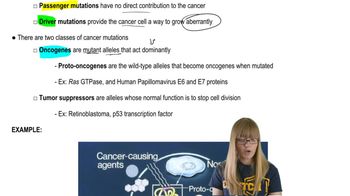
Cancer Mutations

Two-Hit Hypothesis

The two-hit hypothesis explains that both alleles of a tumor-suppressor gene must be mutated or inactivated to lose function. The first 'hit' is often inherited or acquired, and the second 'hit' occurs somatically, leading to cancer progression.
Video consigliato:
Percorso guidato
03:13
Translation:Wobble Hypothesis
Pratica correlata
Domanda del libro di testo

As a genetic counselor, you are asked to assess the risk for a couple with a family history of familial adenomatous polyposis (FAP) who are thinking about having children. Neither the husband nor the wife has colorectal cancer, but the husband has a sister with FAP. What is the probability that this couple will have a child with FAP? Are there any tests that you could recommend to help in this assessment?

723
views
Domanda del libro di testo

If a cell suffers damage to its DNA while in S phase, how can this damage be repaired before the cell enters mitosis?

558
views
Domanda del libro di testo

What is the difference between saying that cancer is inherited and saying that the predisposition to cancer is inherited?

561
views
Domanda del libro di testo

What is apoptosis, and under what circumstances do cells undergo this process?

897
views
Domanda del libro di testo

Part of the Ras protein is associated with the plasma membrane, and part extends into the cytoplasm. How does the Ras protein transmit a signal from outside the cell into the cytoplasm? What happens in cases where the ras gene is mutated?

518
views
Domanda del libro di testo

Describe the steps by which the TP53 gene responds to DNA damage and/or cellular stress to promote cell-cycle arrest and apoptosis. Given that TP53 is a recessive gene and is not located on the X chromosome, why would people who inherit just one mutant copy of a recessive tumor-suppressor gene be at higher risk of developing cancer than those without the recessive gene?

915
views